Introduction
Geopolitics is not a laboratory science. It is born from maps, resources, ambitions, and the simple, brutal reality that the planet has a fixed shape and finite resources. Among all the theories that try to decipher this board, two names shine with their own light: Halford John Mackinder and Zbigniew Brzezinski.
One was a British geographer who, in 1904, outlined a geopolitical prophecy that still resonates today. The other was a Polish-American strategist who turned that prophecy into a roadmap for U.S. hegemony. Together, Mackinder and Brzezinski form the theoretical axis that explains the struggle for control of Eurasia — and by extension, the world — in the 20th and 21st centuries.
This article is part of the Geopolitics of Control series. We have already explored Bertrand de Jouvenel and the natural expansion of power, David Graeber and debt as a tool of control, and Pedro Baños and the 7 levers of domination. Now it is time to rise to the next level of abstraction: the map of the board where the real game is played.
Halford Mackinder and the Heartland Theory
The geographer who changed geopolitics
Halford John Mackinder (1861–1947) was an English geographer, politician, and academic. In 1904, in a paper titled “The Geographical Pivot of History,” he put forward a theory that would forever change how we understand global power: the Heartland theory.
What is the Heartland?
According to Mackinder, the world could be divided into three geopolitical zones:
- The World-Island — the continents of Europe, Asia, and Africa. The largest, most populous, and wealthiest landmass on the planet.
- The Inner or Marginal Crescent — the British Isles, Japan, the Middle East, South Asia.
- The Outer or Insular Crescent — the Americas, Oceania.
At the center of the World-Island lies the Heartland, a region stretching from the Volga River to the Yangtze, and from the Himalayas to the Arctic Ocean. Essentially, the territory of the Russian Empire and the Soviet Union.
Mackinder’s argument is summed up in three devastating sentences:
“Who rules East Europe commands the Heartland; who rules the Heartland commands the World-Island; who rules the World-Island commands the world.”
Why is the Heartland so important?
Mackinder reasoned that this region was inaccessible by sea, occupied a central position, and had enough resources to sustain a land power. An empire that controlled the Heartland would hold decisive strategic advantages over any maritime power.
In his time, Britain’s great fear was that Russia or Germany would dominate that region. Subsequent history — the Cold War, Soviet expansion, the conflict in Ukraine — has proven that Mackinder was not far off the mark.
🔗 To understand how power naturally expands, read our article on Bertrand de Jouvenel.
Nicholas Spykman and the Rimland
Before reaching Brzezinski, we must mention Nicholas Spykman, a geopolitician who proposed a fundamental variation: the Rimland theory.
Spykman argued that control of the rim of Eurasia (the Rimland) was more important than control of the continental heart. The Rimland — Western Europe, the Middle East, South Asia, Southeast Asia — was the contact zone between land power and sea power, and therefore the true key to global dominance.
Spykman reformulated Mackinder’s aphorism:
“Who controls the Rimland rules Eurasia; who rules Eurasia controls the destinies of the world.”
This refinement would prove fundamental for Brzezinski, because the United States, as a maritime power, could not directly control the Russian Heartland — but it could contain it by controlling the Rimland.
Zbigniew Brzezinski and The Grand Chessboard
The architect of American strategy
Zbigniew Brzezinski (1928–2017) served as National Security Advisor to President Jimmy Carter (1977–1981), co-founded the Trilateral Commission, and was one of the most influential geopolitical strategists of the 20th century.
In 1997, when the United States stood as the sole superpower after the fall of the USSR, Brzezinski published The Grand Chessboard: American Primacy and Its Geostrategic Imperatives. The central question of the book was: how should the United States act to maintain its hegemony in the 21st century?
Eurasia as a chessboard
Brzezinski starts from a clear premise:
“Eurasia is the chessboard on which the struggle for global primacy continues to be played.”
And the data backs him up. Eurasia concentrates approximately:
- 75% of the world’s population
- 60% of global GDP
- 75% of known energy resources
- 36% of the Earth’s land surface
For Brzezinski, global power is decided in Eurasia. Whoever controls Eurasia controls the world. And the mission of the United States is to prevent any rival power from emerging that could dominate it.
The geostrategic pivots
Brzezinski identified a set of countries whose geographic position makes them key pieces on the Eurasian board. These are the pivot countries:
| Country | Geostrategic function | Current situation |
|---|---|---|
| 🇺🇦 Ukraine | Prevent Russian imperial restoration. “Without Ukraine, Russia ceases to be a Eurasian empire.” | Active war since 2022 |
| 🇦🇿 Azerbaijan | Caspian energy corridor | Strategic U.S. ally |
| 🇹🇷 Turkey | Bridge between Europe and Asia, control of straits | NATO member, complex relationship |
| 🇮🇷 Iran | Control of the Persian Gulf, vast reserves | Anti-hegemony resistance |
| 🇰🇿 Kazakhstan | Resources and massive territory in Central Asia | Multi-vector diplomacy |
| 🇺🇿 Uzbekistan | Heart of Central Asia | Balancing between powers |
Of all these, Ukraine is the most critical. Brzezinski stated it with crystal clarity:
“Without Ukraine, Russia ceases to be a Eurasian empire.”
The war in Ukraine, which began in 2022, is the tragic confirmation that Brzezinski was right.
🔗 This connects directly to Pedro Baños’s 7 levers of domination, where the military and diplomatic levers unfold across this very board.
The Mackinder–Brzezinski connection: from the Heartland to the global board
The relationship between the two thinkers is one of direct intellectual inheritance. Brzezinski read Mackinder, understood the Heartland theory, and updated it for the post-Cold War world.
What did Brzezinski take from Mackinder?
- The centrality of Eurasia as the stage for global power.
- The importance of the Heartland (Russia, Central Asia).
- The idea that land power can challenge sea power.
What did Brzezinski add?
- The concept of pivot countries as pieces on the board.
- Geopolitical encirclement through military bases (800+ bases surrounding Eurasia).
- Control of chokepoints (strategic maritime straits: Hormuz, Malacca, Suez).
- The strategy of preventing hostile coalitions (China + Russia + Iran).
In essence: Brzezinski took Mackinder’s map and drew a chess strategy on top of it. Mackinder identified the board; Brzezinski wrote the playbook for the United States to win the game.
The COCOMs and the military encirclement of Eurasia
Brzezinski’s strategy did not remain theoretical. It materialized in the U.S. Unified Combatant Commands (COCOMs), which divide the world into zones of military control:
- EUCOM (European Command) — Europe, western Russia. The most critical, headquartered in Stuttgart with ~70,000 personnel.
- CENTCOM (Central Command) — Middle East, Central Asia. Energy control.
- INDOPACOM (Indo-Pacific Command) — Containment of China.
- AFRICOM (Africa Command) — Prevent Chinese and Russian influence in Africa.
The United States maintains more than 800 military bases around the world, forming a ring of containment around Eurasia. Germany (119 bases) and Japan (119 bases) are the main hubs.
🔗 This architecture of control fits with what we saw in Graeber and debt: power is sustained through both military coercion and financial control.
The prophecy fulfilled: China, Russia, and the anti-hegemonic alliance
Brzezinski explicitly warned in 1997 about the most dangerous scenario for U.S. hegemony:
“Potentially the most dangerous scenario would be a grand coalition of China, Russia, and perhaps Iran, an ‘anti-hegemonic’ coalition united not by ideology but by complementary grievances.”
Twenty-five years later, that coalition exists. China, Russia, and Iran have woven together a strategic alliance that combines:
- China’s economic and technological power.
- Russia’s energy resources and territorial mass.
- Iran’s geostrategic position in the Persian Gulf.
China and the New Silk Road
China challenges Brzezinski’s order exactly as he predicted. The Belt and Road Initiative creates trade routes that bypass Western control:
- Connects Eurasia without depending on sea chokepoints controlled by the U.S.
- Creates economic dependencies on China.
- Develops infrastructure (railways, ports, pipelines) that escapes American naval control.
Ironically, it is a strategy Mackinder would understand perfectly: land power reclaiming ground from sea power through railways and continental infrastructure.
Russia’s pivot to Asia
The war in Ukraine and Western sanctions have pushed Russia into a strategic pivot toward Asia:
- The Power of Siberia gas pipeline to China.
- The development of the Arctic Northern Sea Route.
- The energy alliance with Beijing.
🔗 This dynamic of dependency and control is key to the investigation we began with control through debt.
Connection to the Geopolitics of Control series
This article on Mackinder and Brzezinski is not an isolated piece. It is the culmination of a journey we have taken together:
| Article | Connection |
|---|---|
| 🔗 Bertrand de Jouvenel | Power expands by nature; the Heartland and the Grand Chessboard are the map of that expansion. |
| 🔗 David Graeber | Debt and economic control are one of the levers. Brzezinski’s board shows where they are applied. |
| 🔗 Maurizio Lazzarato | The indebted man is the docile subject that sustains the order of the Grand Chessboard. |
| 🔗 John Perkins | Economic hit men operate in pivot countries. |
| 🔗 Nkrumah and Sankara | Financial neocolonialism unfolds across the Eurasian board. |
| 🔗 Pedro Baños | The 7 levers are the tools; Brzezinski’s board is the playing field. |
| 🔗 Galeano and Quijano | The coloniality of power persists in the structure of the global board. |
Mackinder and Brzezinski give us the map. Baños gives us the tools. Jouvenel gives us the driving force: power that expands. Graeber, Perkins, Lazzarato, and Sankara show us the methods: debt, coercion, financial control.
FAQ
What is Mackinder’s Heartland theory?
It is a 1904 geopolitical theory that argues whoever controls the continental heart of Eurasia (the Heartland) will dominate the World-Island (Europe, Asia, Africa) and therefore the world.
Which country represents the Heartland today?
Russia is the natural heir to Mackinder’s Heartland. Its central territory, from Eastern Europe to Siberia, coincides with the region Mackinder identified as the geographical pivot of history.
What is the main difference between Mackinder and Spykman?
Mackinder focused on control of the continental interior (Heartland), while Spykman argued that control of the coastal rims (Rimland) was more important for global dominance.
Is Brzezinski’s Grand Chessboard still relevant in 2026?
Absolutely. The war in Ukraine, the U.S.–China rivalry, the Russia–China–Iran alliance, and the New Silk Road are all phenomena Brzezinski predicted or analyzed in 1997.
Why is Ukraine so important according to Brzezinski?
Because “without Ukraine, Russia ceases to be a Eurasian empire.” Ukraine is the pivot country that separates Russia from direct control of Eastern Europe, and therefore from domination of the Heartland.
How does Brzezinski’s theory connect to the concept of “control through debt”?
Control through debt (which we explored in earlier articles) is one of the levers that, according to Pedro Baños, is used to maintain dominance over pivot countries and strategic regions of the Eurasian board.
What are chokepoints and why do they matter?
They are strategic maritime straits (Hormuz, Malacca, Suez, Panama) through which the majority of global trade passes. Controlling them is equivalent to controlling the arteries of the world economy.
Is China fulfilling Mackinder’s prophecy?
China is using land power (railways, pipelines, the New Silk Road) to bypass American maritime control, exactly as Mackinder predicted a continental power would do.
Conclusion
Mackinder drew the map. Brzezinski wrote the rules of the game. Together, they created the geopolitical framework that explains — perhaps better than any other — why the world is the way it is today.
The struggle for Eurasia is not an academic abstraction. It is the war in Ukraine. It is the rise of China. It is the network of military bases surrounding Russia. It is the control of the straits through which the oil that powers the planet flows. It is, ultimately, the board on which humanity’s oldest game is played: who controls what, and at whose expense.
In upcoming articles, we will explore Michel Foucault and biopolitics — the final piece of the puzzle: how power penetrates bodies and subjectivities to complete control from within.
🌿 This article is part of the Geopolitics of Control series, an investigation into the power structures that govern the world. Subscribe or come back so you don’t miss the next chapters.
Featured image prompt
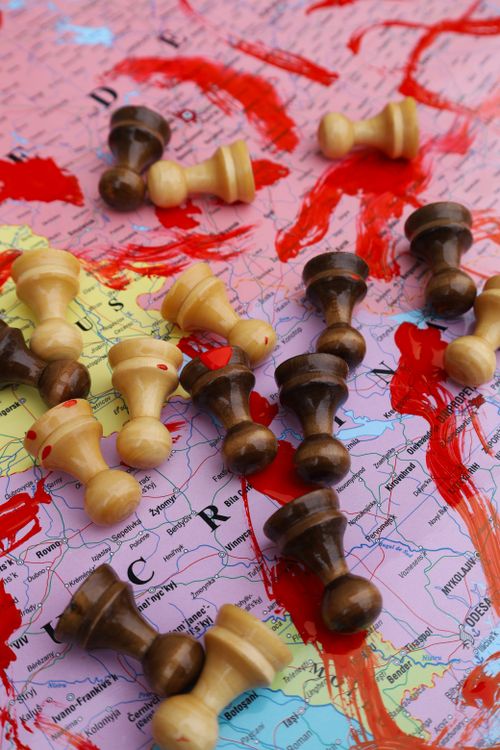
Prompt: Conceptual illustration of a giant chessboard overlaid on a world map, with Eurasia at the center. Gold and silver chess pieces representing global powers. Old map style with modern details. Dark background with dramatic lighting. Epic and strategic composition. Style: blend of historical cartography and conceptual digital art.
ALT text: Artistic representation of Brzezinski’s Grand Chessboard over a map of Eurasia, with chess pieces symbolizing the geopolitical struggle for control of the Heartland.
Recommended external links
- Halford Mackinder — Wikipedia
- Heartland theory — Wikipedia
- Heartland theory: how a 19th-century geographer developed the prophecy that explains today’s world — BBC Mundo
- Zbigniew Brzezinski — Wikipedia
- The Grand Chessboard — Complete analysis (Terapia Liberal)
- Nicholas Spykman and the Rimland theory — Wikipedia
- The Grand Chessboard — Zbigniew Brzezinski (Basic Books, 1997)
- Pedro Baños — World domination
Geopolítica del Control — Article 9 of the series