Introduction
On May 14, 1948, David Ben-Gurion proclaimed the independence of the State of Israel. That declaration, read at the Tel Aviv Museum, was the culmination of a process that had begun decades earlier and would forever transform the Middle East. But what is often presented as the legitimate return of the Jewish people to their ancestral homeland was also, from its very origins, a calculated geopolitical operation. The creation of Israel was not merely the triumph of Zionism — it was another piece on the chessboard of global control.
To understand this, we must go back to the First World War, when the Ottoman Empire was collapsing and the European powers were preparing to carve up its remains. The Balfour Declaration of 1917, the secret Sykes-Picot agreements, and the subsequent British Mandate over Palestine sowed the seeds of a state born under the sign of power and strategy.
Origins: The Balfour Declaration and the Imperial Game
In November 1917, in the midst of the First World War, British Foreign Secretary Arthur Balfour sent a letter to Lord Lionel Walter Rothschild, a leader of the British Jewish community. Just 67 words long, its historical weight is incalculable:
“His Majesty’s Government view with favour the establishment in Palestine of a national home for the Jewish people, and will use their best endeavours to facilitate the achievement of this object, it being clearly understood that nothing shall be done which may prejudice the civil and religious rights of existing non-Jewish communities in Palestine.”
The Balfour Declaration was a strategic move by the British Empire for several reasons. First, Britain needed allies in the war. The support of the international Jewish lobby, especially in the United States and Russia, could tip the balance. Second, establishing a British protectorate in Palestine under the guise of a “Jewish national home” allowed London to strengthen its control over the Suez Canal and the routes to India, the crown jewel of the Empire. Third, the declaration served to counter French ambitions in the region, at a time when the Sykes-Picot agreements (1916) had already divided the Middle East into spheres of influence.
The problem — and it was no small one — is that Palestine was inhabited by an overwhelming Arab majority. In 1917, Jews represented approximately 10% of the Palestinian population. Balfour’s promise deliberately ignored the political rights of the Palestinians, something the British government implicitly acknowledged through the contradictory promises it simultaneously made to Arabs via the Hussein-McMahon correspondence (1915–1916).
As Bertrand de Jouvenel argues in Power, power naturally tends to expand. Britain was not offering a home to the Jewish people out of altruism: it was expanding its influence, using Zionism as a Trojan horse to establish a permanent presence in the heart of the Middle East.
From the British Mandate to the UN Partition Plan
After the dissolution of the Ottoman Empire, the League of Nations granted Britain the Mandate for Palestine in 1922. The Mandate’s text incorporated the Balfour Declaration, committing London to facilitate Jewish immigration and the establishment of the “national home.” Over the following 25 years, Jewish immigration grew steadily, driven by the rise of Nazism in Europe and the systematic persecution of Jews.
World War II and the Holocaust drastically changed the context. The international community, horrified by the scale of the genocide, grew increasingly sympathetic to the Zionist cause. But geopolitical interests were also at play: the United States was emerging as the global hegemonic power and needed allies in the Middle East, especially in a region rich in oil.
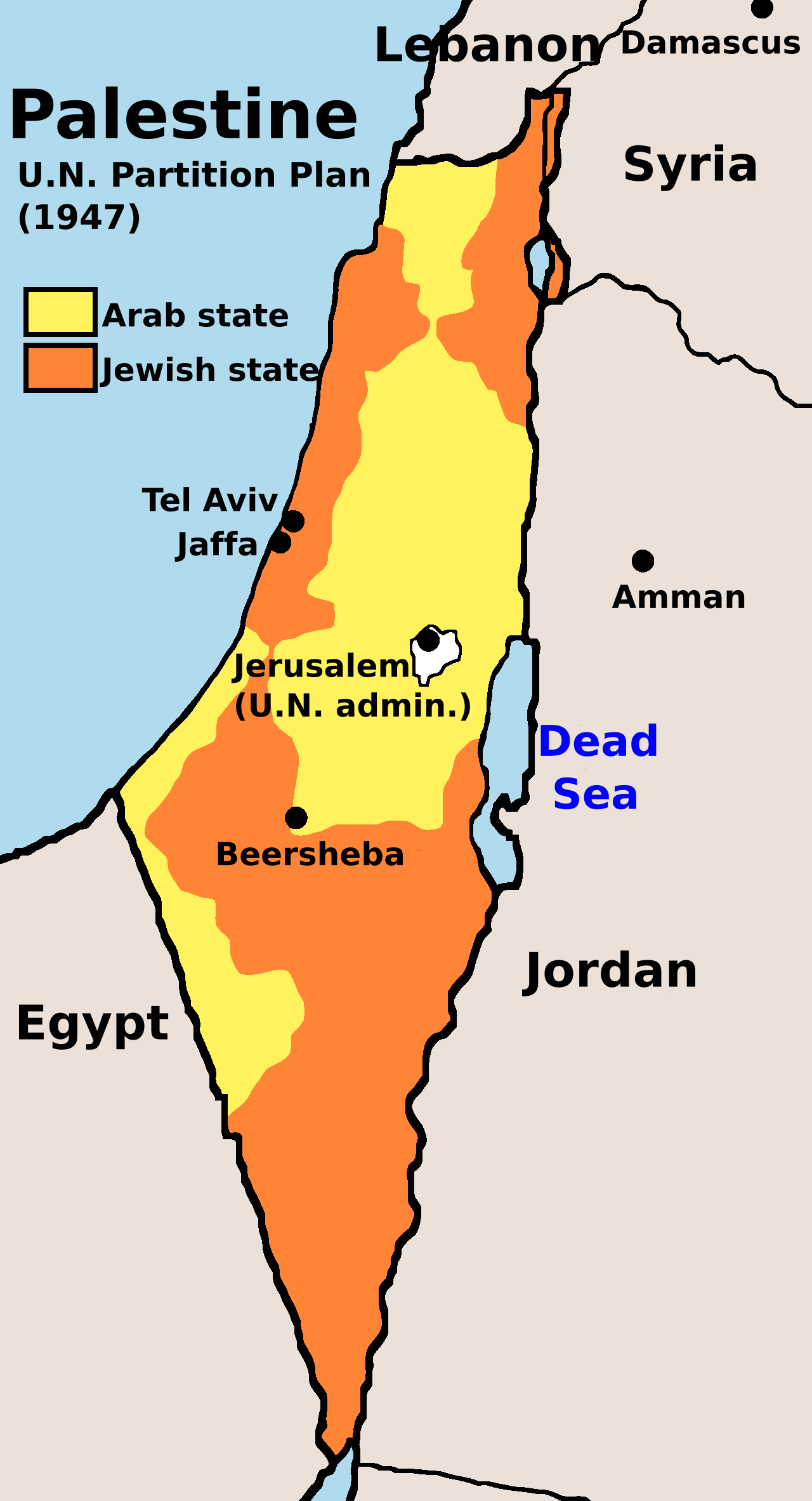
In 1947, the newly created United Nations approved Resolution 181, known as the Partition Plan for Palestine. It proposed dividing the territory into two states — one Jewish and one Arab — with Jerusalem under international administration. The plan granted the Jewish state 56% of the territory, despite the Jewish population representing barely one-third of the total and owning only 7% of the land.
Zionist leaders accepted the plan. Arab states and Palestinians rejected it. The inequality of the division was evident, and for the Palestinian population it meant the loss of their land and homeland in favor of a largely immigrant population.
1948: The Nakba and the Birth of Israel
On May 14, 1948, Britain withdrew its administration and Ben-Gurion proclaimed the State of Israel. The following day, the armies of Egypt, Jordan, Syria, Lebanon, and Iraq invaded the new state. The 1948 Arab-Israeli War had begun.
The military outcome was an overwhelming Israeli victory. Well-organized, equipped with Czechoslovak and Soviet weapons (both powers initially supported Israel), and fiercely motivated, the Israeli army not only repelled the invasion but expanded its borders beyond those established by the Partition Plan. By the end of the war, Israel controlled 78% of Palestinian territory.
For Palestinians, those months were al-Nakba — “the catastrophe” in Arabic. More than 700,000 Palestinians were displaced or fled their homes. Hundreds of villages were destroyed. Those who remained became a minority within the new state, subjected to military rule until 1966.
The United Nations estimated 726,000 registered Palestinian refugees served by UNRWA, an agency created specifically to assist them. Many of them and their descendants — now over 5 million — continue to live in refugee camps in the West Bank, Gaza, Jordan, Lebanon, and Syria, without the implementation of UN Resolution 194, which recognizes their right of return.
The Nakba was not a collateral effect of war: it was, as historians like Ilan Pappé have documented, part of a systematic plan of ethnic cleansing. Plan Dalet, executed by Zionist forces between March and May 1948, established the expulsion of the Palestinian population from strategic areas assigned to the new state.
The American Shift: From the USSR to Washington
One of the lesser-known aspects of this process is the role of the Soviet Union. Stalin initially supported the creation of Israel in 1947–1948, calculating that a Jewish state with a socialist orientation — many Zionist founders were secular Eastern European Jews — could be an ally against British imperialism in the Middle East. The USSR was the first country to recognize Israel de jure, and through Czechoslovakia supplied crucial weapons during the 1948 war.
But the Soviet calculation failed. Israel quickly looked westward. President Harry Truman’s recognition of Israel — just 11 minutes after the proclamation — marked the beginning of an alliance that would become the cornerstone of U.S. policy in the Middle East.
Since then, the United States has provided Israel with over $130 billion in bilateral assistance, most of it military aid. As of 2025, the annual commitment exceeds $3.8 billion in military aid under the latest Memorandum of Understanding signed in 2019. In exchange, Israel acts as the armed watchdog of American interests in the region: an outpost of the West in the Arab world, a reliable military client, and a testing ground for the arms industry.
We have explored in earlier articles how the military-industrial complex uses permanent war as a business. The U.S.-Israel relationship is the perfect example: mass military aid is not charity — it is an investment in regional control.
1967: The Six-Day War and the Occupation
If 1948 was the year of creation, 1967 was the year of expansionist consolidation. In six days — June 5 to 10, 1967 — Israel simultaneously defeated Egypt, Jordan, and Syria in a lightning war that redefined the borders of the Middle East.
The result was the occupation of:
- The West Bank (including East Jerusalem), taken from Jordan.
- The Gaza Strip, seized from Egypt.
- The Golan Heights, strategic Syrian territory.
- The Sinai Peninsula, returned to Egypt after the Camp David Accords in 1979.
The Six-Day War tripled the territory under Israeli control. The occupation of the West Bank and Gaza affected over one million Palestinians who came under military administration — a situation that continues to this day.
The international community’s response was UN Security Council Resolution 242, demanding the “withdrawal from occupied territory” in exchange for peace. Half a century later, the resolution remains unfulfilled. Israel has used all mechanisms of power — military, diplomatic, media — to perpetuate the occupation while building illegal settlements in occupied territory, a strategy of progressive colonization that fragments the West Bank and makes a two-state solution unviable.
The Creation of Israel as a Geopolitical Tool
Analyzed through the framework of Pedro Baños’ seven levers of domination, the creation and maintenance of Israel can be understood as an exercise of control across multiple dimensions:
- Military lever: Israel is the most powerful military force in the Middle East, sustained by U.S. weapons and diplomatic backing. Its army serves as a regional deterrent and an instrument of control over Palestinians.
- Diplomatic lever: The United States has vetoed over 40 UN Security Council resolutions condemning Israel since 1972, shielding it from any effective international sanctions.
- Media lever: The narrative of “the only democracy in the Middle East” has been carefully cultivated to present Israel as a Western bastion in a hostile region, while obscuring the reality of occupation and apartheid.
- Economic lever: Massive U.S. military aid, free trade agreements, and Israel’s integration into the global tech economy make it an indispensable partner.
The creation of Israel fits perfectly with Jouvenel’s theory of power: power naturally expands, and institutions created under its influence tend to perpetuate and grow. Israel was not created to be a small, peaceful state — it was designed, from the Balfour Declaration onward, as a geopolitical tool to maintain Western control over the Middle East.
As we also explored in earlier articles on control through law and sanctions, international legality is applied selectively: demanding with countries that challenge the established order, and flexible with strategic allies. In Israel’s case, UN resolutions, advisory opinions from the International Court of Justice, and reports from human rights organizations have been systematically ignored when they clash with geopolitical interests.
Connection to the Geopolitics of Control Series
This article is part of the “Middle East: The Chessboard of Control” series, which explores how the great powers have used the region to exercise global power. As we saw in the introductory article The Middle East: The Chessboard of Control — Oil, Power, and the Great Game — the region is the stage where all levers of domination are deployed without pretense.
The creation of Israel is the first piece on this board: a state designed to serve as a hinge between continents, a guardian of energy routes, and a spearhead of Western interests. Without understanding its geopolitical origins, one cannot understand the Palestinian-Israeli conflict, the subsequent wars, or the current tensions with Iran.
Upcoming articles in the series will explore in depth Palestine: occupation, settlements, and territorial control, as well as the petrodollar and the role of leaders who challenged the system such as Gaddafi and Saddam Hussein.
FAQ
What was the Balfour Declaration and why was it important?
The Balfour Declaration was a 1917 letter from British Foreign Secretary Arthur Balfour to Lord Rothschild, expressing the British government’s support for the establishment of a “national home for the Jewish people” in Palestine. It was the first endorsement of the Zionist movement by a world power and laid the political groundwork for the creation of Israel thirty years later.
What was the Nakba?
The Nakba — “catastrophe” in Arabic — is the term Palestinians use to describe the forced displacement of over 700,000 people between 1947 and 1949 during the creation of the State of Israel. Hundreds of villages were destroyed and their inhabitants were never allowed to return. Today, Palestinian refugees and their descendants number over 5 million.
Why does the United States support Israel so strongly?
The United States considers Israel a key strategic ally in the Middle East. It provides over $3.8 billion annually in military aid, advanced technology, and diplomatic cover at the UN. In return, Israel acts as an outpost of American interests in a volatile, energy-rich region.
What territories did Israel occupy in the 1967 Six-Day War?
Israel occupied the West Bank (including East Jerusalem), the Gaza Strip, the Golan Heights (from Syria), and the Sinai Peninsula (from Egypt). Sinai was returned to Egypt after the Camp David Accords, but the rest remain occupied, with millions of Palestinians living under Israeli military administration.
What was the difference between the 1947 UN Partition Plan and Israel’s actual borders?
The Partition Plan (Resolution 181) allocated 56% of Palestinian territory to Israel. After the 1948 war, Israel controlled 78%. After the 1967 Six-Day War, Israel controlled 100% of the land between the Mediterranean and the Jordan River, plus the Golan Heights.
Conclusion
The creation of Israel was not an isolated act nor simply the culmination of the Zionist dream. It was the result of a geopolitical calculation in which the British Empire first, and the United States later, used the Zionist project as a tool to maintain control over the Middle East. Like all geopolitical tools, it was created to serve certain interests, and its consequences — the Nakba, the occupation, the permanent conflict — are the price millions have paid on the chessboard of global power.
Understanding Israel’s origins is understanding how power works in the 21st century. The same dynamics of control — strategic alliances, the creation of client states, unconditional military support, manipulation of international law — repeat themselves time and again, because power, as Jouvenel taught us, always seeks to expand.
📚 Related Books
- The Ethnic Cleansing of Palestine — Ilan Pappé
- The Invention of the Jewish People — Shlomo Sand
- Power — Bertrand de Jouvenel
- World Domination — Pedro Baños