Introduction
Colonialism never ended. It merely changed form. Today it arrives not with cannons or warships, but with fiber-optic cables, data centers, algorithms and digital platforms. Digital colonialism is the new frontier of global power: a system in which the great technology corporations —mostly American and Chinese— control the infrastructure, data and innovation frameworks of entire nations, replicating under a modern guise the old center-periphery dynamics of historical colonialism.
Technological dependence, data extractivism, mass surveillance and precarious digital labor are the pillars of this new form of domination. In this article we explore how digital colonialism operates, who its main actors are, what consequences it has for the Global South, and how it connects with the levers of control we have been analyzing throughout this series.
Digital Colonialism: Definition and Origins
The term “digital colonialism” was popularized by Michael Kwet (2019), a South African sociologist who defined it as the power structure exerted by American technology corporations over the Global South, reproducing the logics of economic and epistemic imperialism through digital means. Shortly after, Nick Couldry and Ulises Mejias (2019) coined the sister concept of “data colonialism,” describing how the mass appropriation of personal data constitutes a new phase of extractive capitalism.
These authors draw on a critical tradition that begins with Aníbal Quijano and his theory of the coloniality of power: the idea that colonization did not end with political independence, but persists in the knowledge structures, economic systems and cultural frameworks imposed by the West. Foreign debt, the IMF and now digital infrastructure are successive manifestations of the same global power pattern.
Unlike classical colonialism, digital colonialism does not need to physically occupy territory. It operates through:
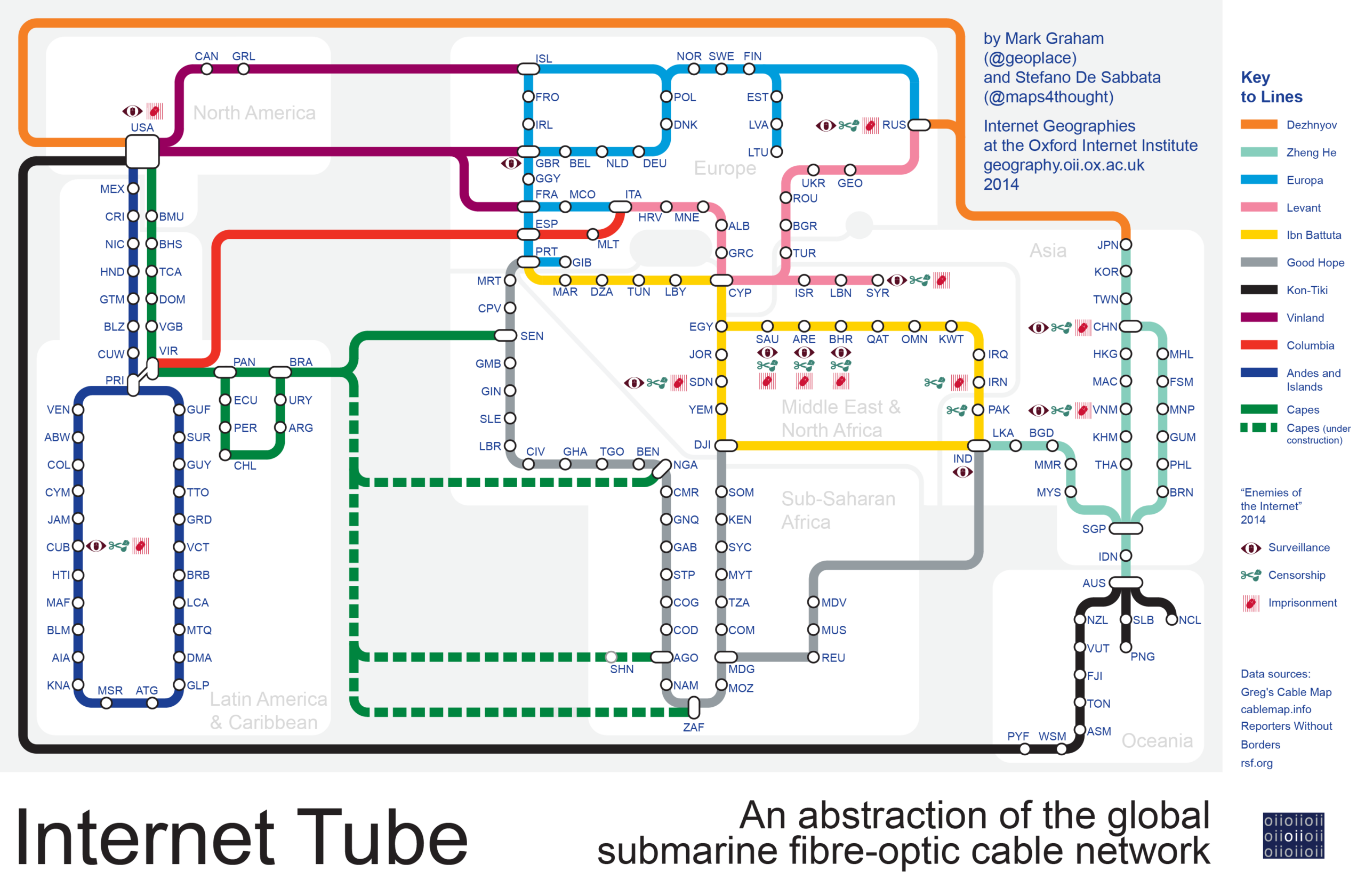
– Infrastructure control (submarine cables, satellites, data centers, cloud computing).
– Mass data extraction from entire populations.
– Imposition of technological standards and regulatory frameworks designed in the Global North.
– Ecosystemic dependence: once a country adopts a technological ecosystem (Google, AWS, Microsoft), leaving it becomes virtually impossible.
The Pillars of Digital Colonialism
1. Ecosystemic Dependence
The first and deepest pillar is ecosystemic dependence. This goes beyond the traditional digital divide —lack of internet access or hardware— to something more structural: the entire innovation cycle of Global South countries takes place within ecosystems defined and controlled by Northern actors.
As an OECD report on competition in AI infrastructure (2025) documents, concentration in the physical and strategic layers of the digital ecosystem —advanced chips, computing capacity, data centers, cloud, networks— is so extreme that the system itself prevents new actors from achieving autonomy. Without formally prohibiting anything, the global technological architecture generates an infrastructure of structural dependence.
For Latin America, the implications are concrete: every startup, university or public institution innovates within platforms controlled by foreign giants. To innovate means to innovate within the limits set by others.
2. Data Extractivism and Surveillance
The second pillar is data extractivism. Every click, every search, every transaction generates data that flows into Big Tech servers. This information is the raw material of digital capitalism: it is refined, processed and converted into economic value without any compensation for those who generate it.
Shoshana Zuboff called this “surveillance capitalism”: a new economic order that treats human experience as free raw material for producing behavior predictions. But in the context of digital colonialism, this extractivism takes on an added geopolitical dimension.
Data from the Global South is extracted en masse, but the profits concentrate among Silicon Valley shareholders. Southern populations not only receive no compensation, but are also subjected to digital surveillance systems that often exceed in scope those deployed in Northern countries. Facial recognition systems, predictive policing and social monitoring technologies are tested and implemented in the Global South with little democratic oversight or community consent.
Africa, home to approximately 2,000 languages —one-third of the world’s linguistic diversity— is a paradigmatic case: as of 2025, the major AI voice systems (Siri, Google Assistant, Alexa) served zero African languages. Linguistic exclusion is also a form of epistemic colonialism.
3. Infrastructure Control and Global Value Chains
The third pillar is control of critical infrastructure:
- Virtually all submarine fiber-optic cables connecting the Global South to the internet are controlled by Northern corporations.
- Data centers that store and process the planet’s information are concentrated in the United States, Europe and China.
- Cloud computing (AWS, Azure, Google Cloud) dominates the global market and conditions everything from government storage to scientific research.
- Chips and semiconductors required for AI and advanced computing depend on an extremely concentrated supply chain (TSMC, NVIDIA, ASML).
Artificial intelligence is reorganizing global value chains in a way that reproduces the center/periphery structure: model design, training and platform infrastructure are concentrated in a few dominant poles, while many countries are relegated to lower-value tasks —data annotation, content moderation, local adaptation of imported solutions.
This digital division of labor echoes the old international division of labor of classical colonialism: some countries design and control; others produce raw materials (data) and cheap labor (labeling, moderation).
4. Precarious Digital Labor
The fourth pillar is labor exploitation. AI training datasets require enormous amounts of human work: labeling images, transcribing audio, moderating content, evaluating responses. This work is massively outsourced to Global South countries —the Philippines, India, Kenya, Venezuela— where wages are a fraction of Western rates.
Kenyan workers moderating traumatic content for Facebook for less than two dollars an hour. Indian annotators labeling millions of images to train autonomous vehicles. Filipino workers transcribing hours of audio for voice assistants. The “click” that trains an algorithm is often the invisible hand of a precarious worker in the Global South.
The Geopolitical Paradox of Digital Sovereignty
In recent years, talk of digital sovereignty has proliferated. The European Union, China and several Global South countries have articulated agendas of technological independence. Yet technological concentration has not decreased: it has deepened.
This is the geopolitical paradox of the moment: fragmentation between blocs does not guarantee emancipation. As recent literature shows, states are redesigning the global digital economy to assert control over the AI value chain, but they do so through semiconductor export controls, infrastructure alliances and platform bans —not through multilateral institutions or by building open alternatives.
The result is that geopolitical fragmentation and technological concentration coexist, and sometimes reinforce each other. Countries attempting to build digital sovereignty end up depending on Chinese platforms instead of American ones, or reproduce European regulatory models without the institutional conditions that make them work.
Real digital sovereignty, as authors like Cecilia Rikap warn, is not achieved through regulatory rhetoric or by simply replacing one foreign provider with another. It requires building endogenous technological capacities: public research, open hardware, free software, local talent development, and legal frameworks that protect citizens’ data.
Connection to the Geopolitics of Control Series
Digital colonialism connects directly with the central thesis of our series: power expands by nature (Jouvenel), and each historical era finds its own tools of domination.
In previous articles we saw how debt (articles 1-14) functions as a neocolonial control mechanism, how the IMF and the World Bank (14) institutionalize it, how energy control (15) ensures resource dependence, how cultural soft power (16) shapes subconscious values, and how the military-industrial complex (17) sustains permanent war as a business.
Digital colonialism adds a fundamental piece to the puzzle: the technology lever from Pedro Baños’ framework. Big Tech exercises an infrastructural power over the 21st century that no Global South state can counter on its own. There is no need to invade a country when you control its data, its communications, its payment systems, its education and its research.
Technology is not neutral. Like debt, like energy, like the media, it is a battlefield where the question of who controls and who is controlled is decided.
FAQ
What is digital colonialism?
It is the power structure through which Global North technology corporations control the digital infrastructure, data and innovation frameworks of Global South countries, reproducing under digital forms the dependency dynamics of historical colonialism.
How is it different from surveillance capitalism?
Surveillance capitalism (Zuboff) describes how tech companies extract and monetize human experience as raw material. Digital colonialism adds a geopolitical dimension: the center-periphery relationship, data extractivism as a new form of colonial exploitation, and the creation of structural technological dependence.
Which countries suffer most from digital colonialism?
Global South countries —Africa, Latin America, much of Asia— are the most affected. They lack their own digital infrastructure while their data, digital labor and markets are exploited by foreign corporations with no significant return to their economies.
Is it related to dependency theory?
Yes. Dependency theory, developed by authors like Raúl Prebisch and Aníbal Quijano, described how peripheral countries remain trapped in a structural relationship of economic subordination. Digital colonialism updates this theory for the 21st century: the terms of digital exchange are as unequal as the terms of trade were in the 20th century.
Are there alternatives to digital colonialism?
Yes. Movements toward digital sovereignty exist: public and community cloud infrastructure, free and open-source software and hardware development, AI models trained with local data, regulatory frameworks that protect citizens’ data, and the construction of endogenous technological capacities in Global South countries. The digital commons movement and open-source initiatives offer concrete paths forward.
Conclusion
Digital colonialism is not a metaphor: it is the contemporary manifestation of a historical pattern of power that stretches back centuries. If classical colonialism was based on territorial occupation and extraction of natural resources, digital colonialism is based on infrastructure control and data extraction. If the former used cannons and colonial administrators, the latter uses algorithms, patents and ecosystemic dependence.
Understanding it is the first step toward resisting it. Because technology, like power, is not neutral. And whoever controls the digital infrastructure of the 21st century controls, to a large extent, the future.
📚 Related Books
- The Costs of Connection: How Data Is Colonizing Human Life and Appropriating It for Capitalism — Nick Couldry and Ulises A. Mejias
- Digital Colonialism: The Rise of the Internet Empire — Michael Kwet
- The Age of Surveillance Capitalism — Shoshana Zuboff
- Coloniality of Power — Aníbal Quijano
- El dominio mental (Spanish) — Pedro Baños
Featured image: Submarine fiber-optic cable map by Stefano.desabbata, CC BY-SA 4.0, via Wikimedia Commons.
