Introduction
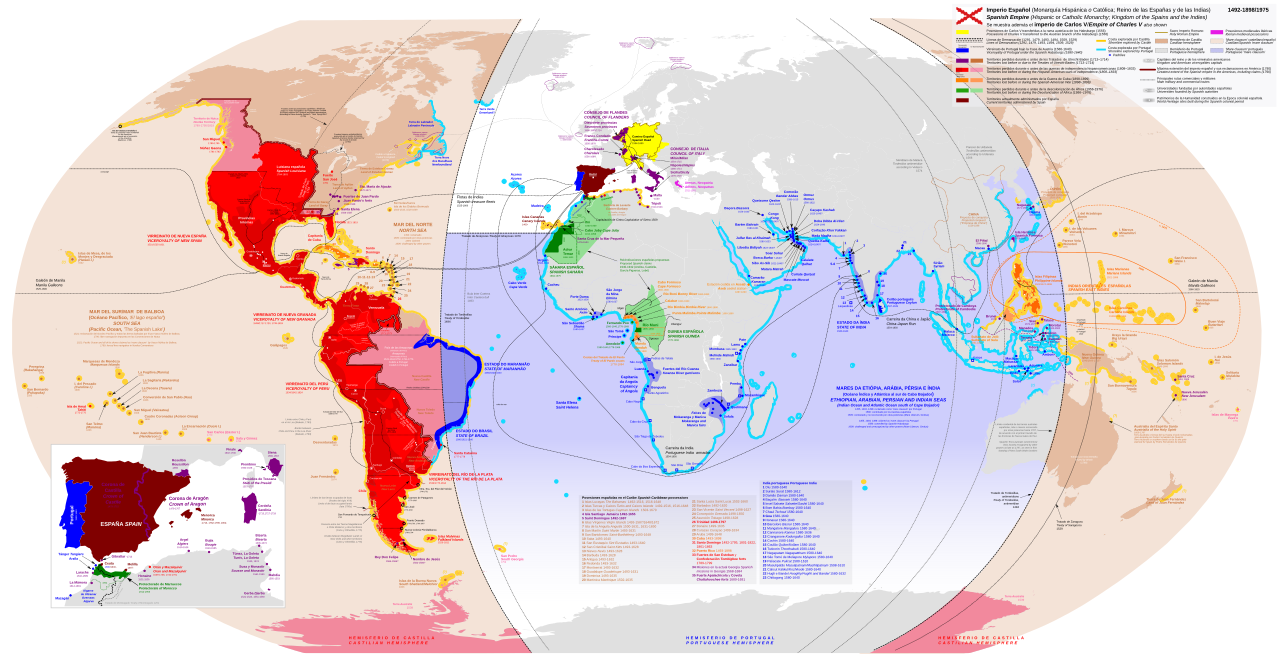
In the early 16th century, Spain built the first global empire in history. Its dominions stretched from California to Tierra del Fuego, from Milan to Manila. It was an empire on which the sun never set, a full century before the English could say the same. For over three hundred years, it was the undisputed superpower of the planet.
Three centuries later, in 1898, Spain lost its last American and Asian colonies in a ten-week lightning war against a country that had once been its own colony: the United States. The Spanish Empire vanished, and with it, four centuries of Spanish presence in the Americas and the Pacific.
But this story is not one of an empire that collapsed from internal decay, technological backwardness, or the inferiority of its people. It is the story of how power conspires to eliminate a competitor. The dismantling of the Spanish Empire was not a historical accident or the inevitable result of time. It was a meticulous geopolitical operation, executed over centuries by rival powers: England, France, the Netherlands, and finally, the United States.
As Bertrand de Jouvenel analyzed, power tends to expand by nature. And when two powers collide, the stronger devours the weaker, or fragments it until it becomes irrelevant. In this article, the first in the «Spain: Laboratory of Control» sub-series, we trace how that dismantling happened and what lessons it offers for understanding geopolitical control.
The Empire That Awakened Envy
To understand how the Spanish Empire was dismantled, we must first understand why others wanted to destroy it.
The Spanish Empire was, at its height (16th–17th centuries), the most powerful and richest state in Europe. It controlled the flow of silver and gold from America, had the most feared army (the tercios), and the largest navy. But it also had a structural weakness: its economy depended on remittances of precious metals, and its enemies — England, France, the Netherlands — quickly learned that attacking the Spanish logistical system was more profitable than facing its armies on the battlefield.
Phase One: Piracy and Privateering
England was the first to understand that it did not need to defeat Spain militarily. It was enough to suffocate its economy. English privateering — piracy with royal patent — was the first tool of attrition. Francis Drake, John Hawkins, and other “heroes” of English history were, by the standards of their time, pirates funded by the English Crown to intercept Spanish galleons returning loaded with silver.
Elizabeth I of England understood that she could not face Philip II in open battle, but she could slowly bleed his empire by attacking his supply lines.
Propaganda as a Weapon: The Black Legend
In parallel, rival powers developed the most successful propaganda campaign in history: the Spanish Black Legend.
Dutch, English, and German Protestants systematically spread images of Spaniards as cruel, fanatical, and degenerate. The work of Bartolomé de las Casas, A Short Account of the Destruction of the Indies, was used and distorted by Spain’s enemies to build a narrative of “Spanish evil” that justified any aggression against the Empire. This narrative — which persists today in the form of Hispanophobia in the Anglo-Saxon world — provided the moral cover for the dismantling that was to come.
The 18th Century: The First Cracks
The 18th century brought two decisive blows to Spanish power.
The first was the War of the Spanish Succession (1701–1714). Upon the death of Charles II without issue, European powers allied to prevent Spain and France from uniting under a single monarch. The result was the Treaty of Utrecht (1713), by which Spain lost its European possessions: Naples, Sicily, Milan, Sardinia, and crucially, Gibraltar, which passed into British hands. It was the first great territorial amputation, and Gibraltar remains a thorn in Spain’s side today.
The second was Britain’s growing dominance of the seas. The defeat of the Spanish fleet at Trafalgar (1805) sealed British naval superiority and left Spain cut off from its American colonies. Without the ability to patrol the Atlantic, the link between the metropolis and its overseas territories became fragile.
1808–1825: The Perfect Storm
The dismantling of the Spanish Empire in America was not a series of spontaneous revolutions. It was the result of a perfect geopolitical storm, where several factors coincided:
Napoleon’s Invasion of Spain (1808)
Napoleon invaded Spain, kidnapped King Ferdinand VII, and placed his brother Joseph Bonaparte on the throne. For the first time in centuries, Spain was decapitated: without a king, without a legitimate government, and fighting a war of independence on its own soil.
The power vacuum was immediate in America. Spanish colonies, without a metropolis to govern them, began forming local governing juntas. In principle, they were loyal to the captive king. But the seed of independence had been planted.
The Role of England
Here enters the decisive factor: England actively supported the Hispanic American independence movements.
Not out of idealism. England had lost its own American colonies in 1776 and needed new markets for its growing industry. An intact Spanish Empire in America was an obstacle. A mosaic of weak, independent countries, however, would be a paradise for British trade.
Lord Castlereagh, the British Foreign Secretary, designed a strategy of “benevolent neutrality” that was actually covert support for the independence movements. Britain provided ships, weapons, and above all, naval control to prevent Spain from sending reinforcements to its colonies.
Simón Bolívar explicitly acknowledged this: without British support and England’s naval dominance, the Hispanic American independences would have been impossible.
The Monroe Doctrine (1823)
When U.S. President James Monroe proclaimed “America for the Americans,” he was sending a clear message to European powers: the United States considered the Western Hemisphere its exclusive sphere of influence.
In practice, the Monroe Doctrine was a declaration of intent: the United States would not allow Spain to recover its American colonies. When Spain attempted to reconquer its lost territories (such as the 1829 attempt against Mexico), the United States and Britain blocked any military operation.
By 1825, Spain only retained Cuba and Puerto Rico in the Americas. The rest of the continental empire was lost.
1861–1865: The U.S. Civil War and Santo Domingo
During the U.S. Civil War, Spain took advantage of Washington’s distraction to reincorporate Santo Domingo (Dominican Republic) in 1861. But when the Civil War ended and the United States regained its strength, diplomatic pressure forced Spain to withdraw in 1865. No one could occupy territory in America without Washington’s permission.
1898: The Year of Disaster
On February 15, 1898, the U.S. battleship USS Maine exploded in Havana harbor, killing 266 sailors. The cause was never determined (later investigations suggest an accidental internal explosion), but the American press, in the midst of a circulation war between Hearst and Pulitzer’s newspapers, immediately blamed Spain.
“Remember the Maine! To hell with Spain!” was the battle cry that led the United States to declare war on Spain on April 25, 1898.
The Ten-Week War
The Spanish-American War was, militarily, an absolute mismatch. The Spanish navy, outdated and poorly prepared, was destroyed in two naval battles: Manila (Philippines) and Santiago de Cuba. In ten weeks, Spain lost everything: Cuba, Puerto Rico, the Philippines, and Guam.
The Treaty of Paris (December 1898) formalized the loss. Spain received 20 million dollars for the Philippines (a legal fiction so the United States could justify its new colony). Cuba did not gain independence: it became a U.S. protectorate through the Platt Amendment, which allowed the United States to militarily intervene in the island whenever it deemed necessary. The Guantánamo naval base remained.
The Consequences
1898 was a national trauma in Spain. It gave rise to the Generation of ’98, an intellectual movement that reflected on Spanish decline. But it was also, for the United States, the moment it presented itself to the world as an imperial power: it had just wrested an empire from the first colonial power in history, and it had done so in less than three months.
The Last Flicker: Africa (1912–1975)
After 1898, Spain focused on North Africa, establishing the Protectorate of Morocco (1912). But even there, external control reached: the Annual Disaster (1921), where 13,000 Spanish soldiers died, was attributed by many to a combination of Spanish poor planning and covert French and British support for the Rif tribes to keep Spain weak.
In 1976, Spain abandoned Western Sahara, its last colonial territory, under international and Moroccan pressure. The empire that began in 1492 ended in 1976: nearly five hundred years of history erased in a few decades.
Connection with the Geopolitics of Control Series
The dismantling of the Spanish Empire is, in many ways, the foundational case of “control through fragmentation” that we have analyzed in this series.
Several of Pedro Baños’ seven levers of domination were systematically applied:
- 📺 Media lever: The Black Legend delegitimized the Spanish presence in America, providing the moral cover for its dismantling.
- 💰 Economic lever: Spain’s external debt and dependence on precious metal flows were weapons used to suffocate the empire.
- 👥 Diplomatic lever: England and the United States wove alliances with Creole elites to foster independences, and diplomatically isolated Spain.
- 🏛️ Military lever: British naval superiority (Trafalgar) and later American (1898) was the decisive factor.
This dismantling also connects directly with David Graeber’s thesis: debt as a tool of control. The Hispanic American wars of independence were largely financed with British loans to the new countries, leaving them trapped in a spiral of debt with the City of London from the moment of their birth as nations.
And, of course, there is the shadow of Bertrand de Jouvenel: power expands by nature, and the vacuum left by Spain was immediately occupied by England (in South America) and the United States (in the Caribbean and the Pacific). Power abhors a vacuum.
To go deeper, we recommend earlier articles in the series:
- The Black Legend — Propaganda, Narrative Control, and the Destruction of an Empire (coming soon)
- Bertrand de Jouvenel — Power Expands by Nature
- Markets Are Founded on Violence — David Graeber and Debt
- Pedro Baños and the 7 Levers of Domination
FAQ
Why did the Spanish Empire fall?
The Spanish Empire did not fall from a single cause. It was a combination of territorial overextension, economic dependence on American gold and silver, military and naval pressure from rival powers (England, France, Netherlands), the propaganda campaign of the Black Legend, and the geopolitical manipulation of independence movements.
Was the 1898 war a just war?
The United States justified the war as a humanitarian intervention to liberate Cuba from Spanish rule. However, after the war, Cuba did not gain independence: it was occupied by the United States and subjected to the Platt Amendment, which allowed Washington to intervene militarily whenever it wished. Puerto Rico, the Philippines, and Guam became American colonies.
What role did England play in the independence of the Spanish colonies?
A crucial one. England actively supported the Hispanic American independence movements through financing, arms supplies, and naval control of the Atlantic, which prevented Spain from sending reinforcements. It did this not out of sympathy for the independence movements, but to open new markets for its industry and weaken a geopolitical competitor.
What is the Spanish Black Legend?
It is the oldest propaganda campaign in history, initiated by Spain’s rival powers (especially Protestants: England, Netherlands, Germany) to portray Spaniards as inherently cruel, fanatical, and degenerate. This narrative morally justified aggression against the Spanish Empire and continues to influence Spain’s international perception today.
Why could Spain not recover its colonies?
After the independences, Spain attempted to reconquer some territories (Mexico in 1829, Santo Domingo in 1861), but was blocked by the United States (Monroe Doctrine) and Great Britain (which controlled the seas). Without a powerful navy, Spain could not project force across the Atlantic.
Conclusion
The dismantling of the Spanish Empire was not a historical accident or the inevitable result of decline. It was the first great modern case of control through geopolitical fragmentation: a dominant power systematically dismantled by its rivals through a combination of propaganda, support for independence movements, economic pressure, and military superiority.
The lessons of this story are timeless. When a hegemonic power weakens, others take its place. The Spanish colonies did not become independent to be free; they passed from one empire to another, from Madrid’s tutelage to the dominant influence of London and later Washington.
Spain lost its empire. But the mechanism that dismantled it — indebtedness, propaganda, manipulation of local elites, selective military intervention — remains the same one that powers use today to control entire countries. Understanding how the Spanish Empire was dismantled is understanding the instruction manual of global power.
This is the first article of the «Spain: Laboratory of Control» sub-series, where we will explore how power has punished Spain for centuries. We invite you to follow the series.
📚 Related Books
- The Power (Le Pouvoir) — Bertrand de Jouvenel
- The Black Legend — Julián Juderías (Spanish)
- Imperiophobia and the Black Legend — María Elvira Roca Barea
- The Spanish-American War — Various authors
- Debt: The First 5,000 Years — David Graeber
- El dominio mundial (Global Domination) — Pedro Baños