Introduction
If war is the continuation of politics by other means, as Clausewitz wrote, then sanctions and international law are the continuation of war by legal means. In the 21st century, military force is no longer the primary instrument of global domination. It has been replaced by a more subtle weapon, cleaner in appearance, and extraordinarily effective: control through law and economic sanctions.
The so-called “rules-based international order” — a phrase coined by Western powers — presents itself as a system of neutral norms that guarantee peace and cooperation among nations. But beneath this surface of impartiality lies a very different reality: international law is, above all, a battlefield where power is codified, legitimized, and exercised. As Bertrand de Jouvenel analyzed, power tends to expand by nature, and one of its most sophisticated forms of expansion is the creation of legal frameworks that benefit those who design them.
In this article, we explore how international law and economic sanctions function as tools of domination, examine their history, their mechanisms, and their consequences, and connect them to the broader framework of Pedro Baños’ seven levers of domination.
International Law as a Construct of Power
To understand control through law, we must begin with an uncomfortable question: who creates the rules of the international game?
Modern international law was born in Europe with the Peace of Westphalia (1648) and developed as a system among European states. When European colonialism expanded across the world, international norms applied fully among colonial powers but did not extend to colonized peoples, considered “uncivilized.” This foundational duality — law for some, exclusion for others — has never fully disappeared.
Legal philosopher Carl Schmitt pointed out in The Nomos of the Earth that international law is not an abstract system of justice but the legal expression of a particular distribution of power and territory. Dominant powers establish the legal framework that best serves their interests and then present it as universal.
The Selectivity of International Law
One of the most persistent criticisms of international law is its selectivity. Not all violations receive the same treatment:
- When the United States invaded Iraq in 2003 without UN Security Council authorization, there were no significant sanctions against Washington.
- When Russia invaded Ukraine in 2022, the broadest sanctions regime in history was deployed.
- When Israel occupies Palestinian territories in violation of numerous UN resolutions, sanctions are limited and systematically vetoed by the United States in the Security Council.
- When North Korea develops nuclear weapons, it receives total sanctions that suffocate its population.
This selectivity is not a defect of the system: it is its fundamental characteristic. International law is not a blind judge but an instrument that great powers use to manage the global order according to their interests.
Economic Sanctions: The Silent War
Economic sanctions have become the preferred instrument of coercion in the 21st century. They are cheaper than war, carry less domestic political cost, and by presenting themselves as “peaceful” measures, they avoid much of the criticism that direct military intervention would generate.
A Brief History of Sanctions as a Weapon
The use of economic sanctions is not new. The first major experiment was the League of Nations, which imposed limited sanctions on Italy during the invasion of Abyssinia (1935-1936). They failed spectacularly, partly because oil was excluded.
After World War II, sanctions were codified in the UN Charter (Article 41), which allows the Security Council to impose measures not involving the use of armed force. But in practice, the most aggressive sanctions have not been multilateral UN sanctions but unilateral ones imposed by the United States.
The modern era of sanctions began with the end of the Cold War. Without the Soviet counterweight, the United States began using sanctions with increasing aggression:
- Cuba (1960–present): The longest embargo in history, spanning six decades, which has been tightened rather than loosened over time.
- Iran (1979–present): A growing sanctions regime that has intensified especially since 2010, targeting Iran’s nuclear program but with devastating effects on the civilian population.
- Iraq (1990–2003): UN sanctions against Saddam Hussein’s regime caused, according to UNESCO, the deaths of over 500,000 children due to lack of medicine and food. Madeleine Albright, then U.S. Ambassador to the UN, when asked whether the price was worth it, replied: “We think the price is worth it.”
- Venezuela (2017–present): Financial and oil sanctions that have accelerated the country’s economic collapse.
- Russia (2014–present, intensified in 2022): The broadest sanctions regime ever applied, including the freezing of Russian central bank assets, an unprecedented move.
How Sanctions Work as a Control Mechanism
Sanctions are not simply punishment. They are a mechanism of global discipline operating on several levels:
-
Deterrence: Sanctions warn other countries of the consequences of challenging the hegemonic power. Syria, North Korea, Iran — all are examples that others observe.
-
Economic strangulation: By cutting off access to international financial markets, technology, and trade, sanctions weaken the targeted country’s economic capacity and, with it, its political resistance.
-
Diplomatic isolation: Sanctions are usually accompanied by a diplomatic pressure campaign that isolates the target country within international institutions.
-
Collective punishment: Although presented as measures against regimes, sanctions disproportionately affect the civilian population, generating discontent that can destabilize the government or, more frequently, radicalize the population against the outside world.
Extraterritoriality: When Sanctions Know No Borders
One of the most controversial features of U.S. sanctions is their extraterritoriality. The United States not only sanctions countries or individuals but also punishes any company or person in the world that does business with the sanctioned country. This is possible because the dollar remains the dominant currency in international trade and because the global financial system (SWIFT, correspondent banks) flows through New York.
The result is that Washington can impose its will not only on its enemies but also on its allies. European, Asian, or Latin American companies are forced to comply with U.S. sanctions or risk being excluded from the U.S. financial system. This has generated growing tensions with the European Union and with countries like China, which are seeking alternatives to dollar dominance.
The “Rules-Based Order”: A Concept Without Definition
Since the 1990s, Western leaders have used the phrase “rules-based international order” to describe the global system they claim must be defended. But when asked what exactly those rules are, the answer is surprisingly vague.
Indian scholar B. S. Chimni, one of the founders of the TWAIL movement (Third World Approaches to International Law), has argued that the “rules-based order” is actually a euphemism for an international order designed by and for Western powers, where rules are applied selectively according to geopolitical convenience.
Chimni is not alone. From the realist school of international relations, authors like John Mearsheimer have pointed out that the “rules-based order” is, in practice, an interest-based order. When rules coincide with the interests of great powers, they are applied with full force. When they do not, they are reinterpreted, ignored, or discarded.
The Paradox of International Law
International law is caught in a fundamental paradox. On one hand, it has achieved real progress in protecting human rights, limiting war (international humanitarian law), and creating institutions such as the International Criminal Court. On the other hand, its selective application and capture by great powers generates deep skepticism, especially among countries of the Global South.
This paradox does not invalidate international law, but it demands a critical look at who writes it, who interprets it, and who enforces it. As legal philosopher Hans Kelsen noted, law is ultimately a question of power: the norm exists because there is someone with the authority (and the force) to enforce it.
Sanctions as Spectacle: The Case of the Security Council
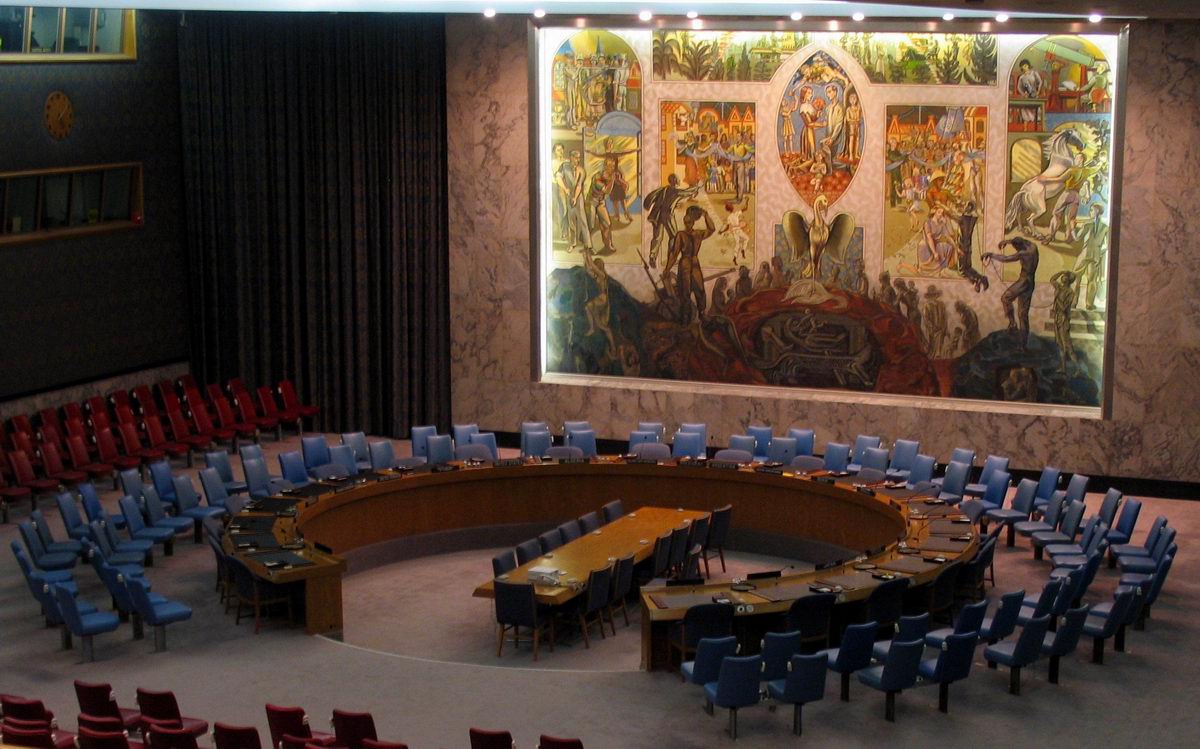
The UN Security Council is perhaps the best example of how international law functions as a theater of power. Its five permanent members (United States, Russia, China, United Kingdom, France) have veto power, meaning any resolution affecting the interests of a great power can be instantly blocked.
Since 1945, the United States has used the veto more than 80 times, mostly to protect Israel from resolutions condemning its actions in occupied territories. Russia has used it to block resolutions on Syria and Ukraine. China uses it to protect itself and its allies.
The result is a system where international law is applied with full rigor to small and medium-sized countries but bends before the great powers. The law is like a spider’s web: the mosquitoes get caught, but the wasps break through.
Connection with the Geopolitics of Control Series
This article is part of our exploration of the seven levers of domination systematized by Pedro Baños, which we have been breaking down throughout the series. Control through law and sanctions represents a fascinating intersection of several of these levers:
- Economic lever: Sanctions are, above all, an economic weapon. They cut off access to credit, trade, and financial markets. This connects directly with our article on the IMF and the World Bank as guardians of debt.
- Diplomatic lever: Sanctions are articulated through international institutions (UN, EU) and reinforced by diplomatic pressure.
- Military lever: Although sanctions claim to be an alternative to war, they are often its precursor or companion, as we saw in the military-industrial complex article.
Control through law also connects with David Graeber’s central thesis: debt as a tool of social control. Sanctions, by financially isolating a country, push it toward default and a position of negotiating weakness that recalls the historical cycle Graeber described in Debt: The First 5,000 Years.
And, of course, there is the shadow of Bertrand de Jouvenel: power expands by nature. International law and sanctions are the legal manifestation of that expansion, the attempt to codify domination in legal language.
To go deeper, we recommend earlier articles in the series:
- The IMF and the World Bank — The Guardians of Debt
- Pedro Baños and the 7 Levers of Domination
- Markets Are Founded on Violence — David Graeber and Debt
- Energy Control: Oil, Gas and Resources
FAQ
Are economic sanctions a form of war?
Many legal scholars and political scientists consider economic sanctions to constitute an act of economic warfare. Although they do not involve the direct use of armed force, their effects on civilian populations can be devastating, as seen in Iraq, Cuba, and Venezuela. The UN has acknowledged that economic sanctions can violate fundamental human rights.
Who decides which countries are sanctioned?
Multilateral sanctions are decided by the UN Security Council, where five countries hold veto power. Unilateral sanctions are imposed by countries such as the United States, the European Union, or their allies without international approval. In practice, most significant sanctions are led by the United States.
Is international law truly universal?
International law aspires to be universal, but its origins, development, and application are deeply marked by colonial history and the interests of great powers. Critics from the TWAIL (Third World Approaches to International Law) school argue that international law is an inherently Western project that serves to perpetuate unequal power relations.
Are there alternatives to dollar dominance in sanctions?
Yes. China, Russia, and other countries are developing alternative international payment systems (such as China’s CIPS or Russia’s SPFS) to reduce their dependence on the dollar and the SWIFT system. The BRICS have discussed creating a common currency and bilateral clearing systems that would bypass U.S. extraterritorial sanctions.
Can sanctions ever be legitimate?
Some advocates argue that targeted multilateral sanctions with clear humanitarian exemptions can be a legitimate instrument of international pressure against serious human rights violations. However, evidence suggests that sanctions rarely achieve their stated objectives and often cause more harm than they aim to prevent.
Conclusion
Control through law and sanctions is perhaps the most sophisticated manifestation of power in the 21st century. It needs neither tanks nor bombs — only laws, decrees, and the capacity to disconnect a country from the global financial system to subdue it. It is clean, it is legal (at least in appearance), and it is extraordinarily effective.
But this very effectiveness reveals the deep nature of power, that expansive tendency Jouvenel identified: power always seeks new channels, new tools, new ways to perpetuate itself. Law, which should be the instrument of freedom and justice, becomes instead the language of domination.
Understanding how this mechanism works is the first step toward questioning it. In a world where rules are written by the powerful, the critical task is always to ask: who benefits from these rules? Who designed them? And who can change them?
If you found this analysis useful, we invite you to explore other articles in our Geopolitics of Control series. Knowledge is the first line of defense against domination.
📚 Related Books
- The Nomos of the Earth — Carl Schmitt
- Debt: The First 5,000 Years — David Graeber
- Third World Approaches to International Law — B. S. Chimni and others
- El dominio mundial (Global Domination) — Pedro Baños
- The Power (Le Pouvoir) — Bertrand de Jouvenel