Introduction
On November 20, 1975, Francisco Franco died in his bed at La Paz Hospital, surrounded by his family and the highest authorities of the regime. His death, after almost forty years of dictatorship, opened a power vacuum that someone had to fill.
The question hanging over Spain was: who gets the power? The answer, as we saw in the previous article, was not spontaneous. It was the result of a process carefully managed from both inside and outside the country.
In this article, the seventh in the «Spain: Laboratory of Control» sub-series, we analyze how power was divided after Franco’s death: how the regime’s elites recycled themselves as democrats, how the forgetting of the dictatorship’s crimes was negotiated, how a Transition that never looked back was designed, and how Spain entered democracy with the power structures of Francoism practically intact.
November 20: The Day Everything Changed and Nothing Changed
Franco died officially at 4:20 in the morning of November 20, 1975. That same morning, Prince Juan Carlos de Borbón swore the Principles of the National Movement as the new head of state.
Juan Carlos’s coronation speech was revealing. He did not promise a break with Francoism, but “a monarchy that does not want privileges inherited from the past, and that does not want to fall into the temptation of using power.” He promised to be the king of all Spaniards — of the victors and the vanquished — and announced a future of change within legality.
But real power at that moment did not reside in the King. The government was still that of Carlos Arias Navarro, Franco’s last prime minister. The Cortes were still Francoist. The National Council of the Movement still existed. Power was in the hands of the same men who had governed with Franco.
The Transition was not a takeover of power: it was a negotiation between elites.
The Two Souls of the Regime
Francoism was not a monolithic block. Within it existed two major tendencies:
1. The Bunker (immobilists): Those who favored keeping the regime intact after Franco. Led by sectors of the military, the old Falangist guard, and the ultras of the Movement. Their motto was “everything tied up and well tied up.”
2. The Aperturistas (reformists): Those who understood that the regime needed reforms to survive. They came from technocratic sectors (many linked to Opus Dei), the state administration, and the moderate Catholic hierarchy. Their most prominent figure was Adolfo Suárez.
In between, external actors — the King, the United States, European countries — pushed in different directions. The result was a Transition that was neither a democratic break nor an authoritarian continuity, but a negotiated reform.
The Law for Political Reform (1976)
The first major move was the Law for Political Reform, promoted by Adolfo Suárez — appointed Prime Minister by the King in July 1976 — and approved by the Francoist Cortes in November 1976. It was an act of self-liquidation of the regime from within: the Francoist Cortes themselves approved a law that dissolved them and opened the way to a democratic system.
The gesture was brilliant: the Francoists themselves, voting overwhelmingly in favor, legitimized the change. In exchange, they were guaranteed that there would be no purge of responsibilities. No one would be held accountable.
In December 1976, the Law was ratified by popular referendum. 94% of voters said yes.
The Amnesty Law of 1977: The Pact of Forgetting
On October 15, 1977, the newly elected democratic Cortes approved the Amnesty Law. The law amnestied all political crimes committed during Francoism, both by opponents of the regime and by state security forces.
In practice, the law meant:
- Impunity for Francoist crimes: Police, judges, and military personnel who had tortured, imprisoned, and executed opponents were exempt from criminal responsibility.
- Release of political prisoners: The last prisoners of the dictatorship left the jails.
- Closing wounds without healing them: There would be no truth commission, no trials, no complete historical reparation.
This tacit agreement is known as the Pact of Forgetting. It was the indispensable condition for a peaceful Transition: the Francoists accepted democracy in exchange for their crimes not being investigated.
The Moncloa Pacts (1977)
In October 1977, Suárez’s government and the main political parties — including the recently legalized Communist Party — signed the Moncloa Pacts. They were economic and social agreements to stabilize the Spanish economy in the midst of crisis.
The pacts included:
– Devaluation of the peseta
– Wage restraint
– Tax reform
– Control of public spending
The Moncloa Pacts were presented as an exercise in responsibility and consensus. But they also had a political effect: they tied Spanish economic policy to guidelines set by Western powers and the IMF, limiting the sovereignty of future democratic governments.
The Constitution of 1978: The Great Consensus
The Spanish Constitution of 1978 was the result of consensus among political forces, from the recycled Francoist right (Manuel Fraga’s People’s Alliance) to the Communist Party.
The Constitution established:
– A democratic system
– Parliamentary monarchy
– The State of Autonomies
– Fundamental rights
But it also left out uncomfortable questions:
– The form of state (monarchy) was not subjected to a specific referendum
– The role of the military was left ambiguously defined
– National plurality was not explicitly recognized
– The economic structures inherited from Francoism were barely modified
The Recycled Elites
One of the most notable aspects of the Transition was the capacity of Francoist elites to recycle themselves as democrats without losing power:
- Manuel Fraga: Franco’s Minister of Information and Tourism, founder of the People’s Alliance. He ended up as president of the Xunta de Galicia in democracy.
- Adolfo Suárez: Civil governor and president of the Ávila provincial council during Francoism, he became the first democratic prime minister.
- Judges and prosecutors: Most Francoist judges and prosecutors continued in their positions during democracy.
- Security forces: The police and Civil Guard barely underwent structural changes.
- The military: Remained practically intact, and its role in the Transition was decisive (as seen in the 23-F).
No one responsible for Francoist repression was tried, no one was removed from their position for their actions during the dictatorship. The Pact of Forgetting ensured that the same people who had sustained the regime continued to occupy positions of power in democracy.
Connection with the Geopolitics of Control Series
The division of power after Franco’s death is a case of control through tutored transition and pact of impunity. Several of Pedro Baños’ levers align:
- 👥 Diplomatic lever: Consensus among elites — inside and outside Spain — ensured a stable and predictable Transition.
- 📺 Media lever: The Pact of Forgetting was also a media pact: the press avoided investigating Francoist crimes for years.
- 🏛️ Military lever: The military remained a key actor, watching that the Transition did not veer too far to the left (23-F was the reminder).
It connects directly with the previous article — the assassination of Carrero Blanco — and with the one on Franco and Kissinger: without Carrero’s death, the Transition would have been different. And without the Pact of Forgetting, it might not have been possible.
To go deeper:
– The Assassination of Carrero Blanco
– Franco and Kissinger
– The 23-F — Real or Controlled Coup? (coming soon)
FAQ
What was the Pact of Forgetting?
It was a tacit agreement among political forces during the Transition to neither investigate nor judge crimes committed during Francoism, in exchange for guaranteeing a peaceful transition to democracy. It was legally formalized with the 1977 Amnesty Law.
Did the Transition bring justice for Francoist victims?
No. The 1977 Amnesty Law prevented any investigation or conviction of dictatorship crimes. Francoist victims did not obtain justice during the Transition, and historical memory claims remain controversial in Spain today.
How did Francoist elites recycle themselves in democracy?
Many high-ranking Francoist officials continued their political careers in democracy: Manuel Fraga founded the People’s Alliance, Adolfo Suárez led UCD and became prime minister, and most regime judges, prosecutors, and police chiefs kept their positions without being purged.
What were the Moncloa Pacts?
They were economic and social agreements signed in 1977 between the government and the main political parties to stabilize the Spanish economy. They included peseta devaluation, wage restraint, and tax reform. They also limited the economic sovereignty of future democratic governments.
Why was a referendum on the monarchy avoided?
The 1978 Constitution established the parliamentary monarchy without submitting it to a specific referendum. The decision was made to avoid jeopardizing the constitutional consensus: republican parties — including the PCE and some PSOE sectors — accepted the monarchy in exchange for other democratic advances.
Conclusion
The Spanish Transition has been presented as a model of national reconciliation. And in many ways it was: political violence was minimal, consensus was broad, and democracy was consolidated.
But this model came at a price. The Pact of Forgetting guaranteed impunity for dictatorship crimes. Francoist elites recycled themselves as democrats without losing their power. The economy was aligned with Western guidelines without public debate. And the monarchy was consolidated without being ratified by the people.
Control through tutored transition is one of the most subtle tools of power: it changes a country’s political form — from dictatorship to democracy — but preserves power structures and ensures no one looks back. Spain was a perfect laboratory for this technique.
This is the seventh article of the «Spain: Laboratory of Control» sub-series.
📚 Related Books
- The Spanish Transition — Javier Tusell (Spanish)
- The Pact of Forgetting — Various authors (Spanish)
- Anatomy of the Transition — Pilar Urbano (Spanish)
- The Power (Le Pouvoir) — Bertrand de Jouvenel
- El dominio mundial (Global Domination) — Pedro Baños
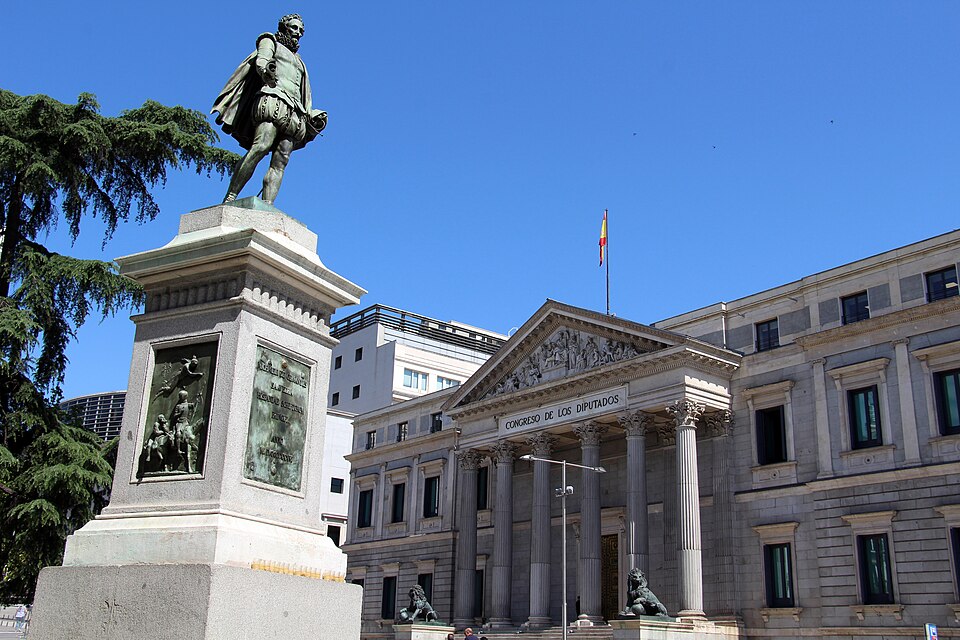
Featured image: Palace of the Cortes (Congress of Deputies), Madrid. Photo by Jorge Lascar, CC BY 2.0, via Wikimedia Commons.
.jpg)