Introduction
When the United States launched the Marshall Plan in 1947 — the most ambitious economic aid program in history — Spain was a country devastated by civil war and internationally isolated. While France, the United Kingdom, Germany, and Italy received billions of dollars to rebuild their economies, Spain watched from the sidelines, excluded for its Francoist regime and its past sympathies with the Axis powers.
But European reconstruction aid did not simply bypass Spain: it arrived later, with harsher conditions, and at a strategic price that mortgaged the country’s sovereignty for decades. The “American aid” was not a gift: it was payment for turning Spain into a US military platform in Southern Europe.
The Marshall Plan: The Western Reconstruction Machine
The Marshall Plan — officially the European Recovery Program (ERP) — was approved in April 1948 and operated for four years. The United States provided about $13 billion of the time (equivalent to roughly $150 billion today) to 18 European countries to rebuild their economies, modernize their industry, and above all, contain the advance of communism in a continent devastated by World War II.
The largest recipient was the United Kingdom (26% of the total), followed by France (18%) and West Germany (13%). Countries that needed it most received it, as did those that were strategically vital to the Western bloc. But Spain, arguably among those that needed it most, was left out.
Why Was Spain Excluded?
Franco’s regime, which had come to power with the help of Hitler and Mussolini, was a stain on the postwar architecture. In December 1946, the UN General Assembly passed a resolution condemning the Francoist regime and recommending the withdrawal of ambassadors from Madrid. Spain was excluded from the Marshall Plan, from the newly created NATO (1949), and was blacklisted from the GATT and other international organizations.
The country was also suffering from its own economic policies: the Francoist autarky, based on isolation, protectionism, and state interventionism, had driven the economy to a critical state. Rationing, hunger, and industrial stagnation were the norm in 1940s Spain.
The Cold War Turning Point
The rift between the former World War II allies radically changed Spain’s strategic position. As the Cold War took hold and the Korean War broke out in June 1950, Franco’s regime ceased to be a pariah and became a potential ally against Soviet communism.
Western powers began to recognize Spain’s geostrategic value: control of the Strait of Gibraltar, the Canary Islands as an Atlantic base, and the peninsula as a rear-guard for the US military apparatus in Europe. As historian Enrique Moradiellos noted: “the Francoist dictatorship went, in barely five years, from being condemned by the United Nations to being courted as a military ally.”
In November 1947, the US successfully opposed a new condemnation of Franco at the UN. In 1948, France reopened its border with Spain. In 1950, the US Senate authorized a $62.5 million loan to Spain through the Export-Import Bank. And that same year, the UN revoked its 1946 condemnation resolution: 38 countries voted in favor, 10 against.
Spain was no longer alone.
The Madrid Pacts of 1953: Bases for Aid
On September 23, 1953, the so-called Madrid Pacts were signed at the Palacio de Santa Cruz in Madrid. They were three executive agreements between the United States and Spain that established:
- Supply of war materiel from the US to Spain.
- Economic aid, including loans managed by the Export-Import Bank.
- Mutual defense assistance: the establishment of joint military bases.
In exchange for economic and military support, Spain authorized the United States to “develop, maintain, and use for military purposes” zones and facilities on Spanish territory.
The Price of Aid
The economic aid Spain received between 1953 and 1963 amounted to just over $1.5 billion, primarily in loans to purchase US products: food, cotton, and coal. Military aid totaled $456 million in second-hand war materiel — which at least helped modernize armed forces still using Italian and German weapons from the Civil War.
In exchange, the United States installed five military bases on Spanish soil:
- Torrejón de Ardoz Air Base (Madrid)
- Morón Air Base (Seville)
- Zaragoza Air Base
- San Pablo Air Base (Seville)
- Rota Naval Station (Cádiz)
Approximately 7,000 US military personnel were deployed there with their families, along with civilian staff. The agreement included a secret protocol — not revealed until many years later — by which the United States could unilaterally decide when to use the bases “in case of evident communist aggression threatening Western security,” without any obligation to consult the Spanish government. Nuclear weapons were stored at these bases, including on nuclear submarines, even at Torrejón, just a few kilometers from Madrid.
An Unequal Agreement
The signing ceremony itself reflected the asymmetry of the pact. Spain was represented by its Foreign Minister, Alberto Martín-Artajo, and its Minister of Commerce, Manuel Arburúa. The United States was represented only by its ambassador in Madrid and the president of the US Chamber of Commerce in Spain.
The agreement was not a treaty — which would have required US Senate approval — but a simple executive pact, precisely because most senators refused to formally endorse Franco’s regime.
Spain was incorporated into the Western defense system, but with neither voice nor vote: the country was blocked from entering NATO until 1982, nearly three decades later.
The Legacy of “American Aid”
US aid had contradictory effects. On one hand, it provided food, coal, and raw materials that alleviated the critical postwar situation. Loans allowed imports of essential goods that the autarkic system could not produce. Military modernization, though modest, was real.
But on the other hand, the aid mortgaged Spanish foreign policy for decades. The Francoist regime became tied to the United States with little room for maneuver. The military bases functioned as enclaves of limited sovereignty: theoretically joint, but in practice Washington decided their use.
Moreover, the aid was not a development plan: it was credit, not subsidy. Spain had to repay it with interest, buying US products that were often more expensive than those on the European market. There was no “Spanish Marshall Plan” that transformed the country’s industry; there was a strategic exchange: military sovereignty for economic aid.
Connection to the Geopolitics of Control Series
The case of the Marshall Plan in Spain is a perfect example of how control through economic and strategic pressure operates. As we explored in The IMF and the World Bank, debt and conditional loans are tools of domination that limit the sovereignty of recipient countries.
Economic historian Fernando Guirao demonstrated that Spain would have needed about $1.2 billion from the Marshall Plan between 1948 and 1951 — a figure comparable to what it eventually received, but arriving late and under far more onerous conditions.
Franco’s Spain traded military sovereignty for economic survival. And although the regime survived thanks to this pact, the country paid the price of a strategic dependency that would last for decades. The bases remain operational today, and it was not until 2023 that the Spanish government began seriously renegotiating the terms of the agreement.
As we explored in Franco and Kissinger and The Division of Power After Franco’s Death, US strategy toward Spain was not accidental: it was a deliberate policy of long-term control, combining diplomatic pressure, temporary isolation, calculated clemency, and ultimately, subordinate integration into the Western bloc.
FAQ
Why didn’t Spain receive the Marshall Plan?
Spain was excluded from the Marshall Plan (1948-1951) due to international rejection of the Francoist regime, which had collaborated with Hitler and Mussolini. In 1946, the UN condemned the regime and recommended the withdrawal of ambassadors, preventing its participation.
When did US aid arrive in Spain?
Aid arrived through the Madrid Pacts of 1953, five years after the Marshall Plan began. Between 1953 and 1963, Spain received about $1.5 billion in loans and $456 million in military materiel.
What were the Madrid Pacts of 1953?
They were three agreements between the United States and Spain that established five US military bases on Spanish territory in exchange for economic and military aid. They were signed on September 23, 1953.
What military bases did the US install in Spain?
Five main bases: Torrejón de Ardoz (Madrid), Morón (Seville), Zaragoza, San Pablo (Seville), and Rota Naval Station (Cádiz). Approximately 7,000 US military personnel were deployed there.
What were the consequences for Spanish sovereignty?
The bases were theoretically under joint sovereignty, but a secret protocol allowed the US to use them unilaterally. Spain could not join NATO until 1982, and its foreign policy remained aligned with US interests for decades.
Conclusion
The Marshall Plan did not bypass Spain: it arrived later, with harsher conditions, disguised as “American aid.” The Francoist regime traded sovereignty for survival, and the United States got what it really wanted: a strategic foothold in Southern Europe for the Cold War.
The story of the Marshall Plan in Spain is a lesson in how great powers use economic aid as a tool of control. It is not just charity: it is geopolitics. And as in so many other episodes in our series, power expands, debt is used as a lever, and sovereignty is negotiated — almost always to the disadvantage of the weaker party.
📚 Related Books
- Spain and the Reconstruction of Western Europe 1945-57 — Fernando Guirao
- American Aid to Spain (1953-1963) — Lorenzo Delgado Gómez-Escalonilla
- Franco and the United States: Bases, Economy, and Dependency — Enrique Moradiellos
- Franco’s Secret Pacts with the United States — Ángel Viñas
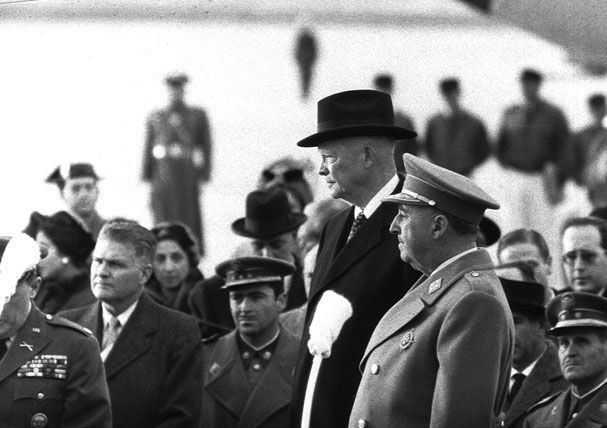
Featured image: Franco and Eisenhower at Torrejón Air Base (1959). Public domain. The photograph symbolizes the Madrid Pacts of 1953 that established US military bases in Spain in exchange for economic aid.
