Introduction
Spain holds one of the richest artistic heritages in the world. From the paintings of Velázquez and Goya to Romanesque altarpieces and the manuscripts of El Escorial, the country was for centuries a crucible of creation and patronage. But there is a parallel, darker story: the systematic pillaging of that heritage under pressure from foreign powers and domestic elites.
From the Napoleonic Wars to the Civil War, passing through the 19th-century confiscations, thousands of works of art left Spain — many never to return. This was not random wartime looting. It was, in many cases, a deliberate policy of cultural appropriation that emptied convents, churches and palaces to fill the museums of rival powers.
This article explores the history of Spanish art plunder as one of the most subtle and enduring levers of domination: control over a nation’s memory, identity and cultural heritage.
Napoleonic Looting: The Most Devastating Plunder in Spanish History
The Peninsular War (1808–1814) was the scene of the greatest cultural theft Spain has ever suffered. Napoleon’s troops did not simply raze cities and convents: they designed an organized system of art looting unprecedented in modern history.
Napoleon had already perfected his method in Belgium, Holland, and Italy: looting under threat of death, official seizure under the pretext of creating a great national museum (the Louvre, then called the Musée Napoléon), selection by specialized dealers, and systematic shipment to Paris. French intellectuals justified the theft by arguing that the works belonged in “the land of liberty” — France — as though the genius of Rubens, Velázquez, or Murillo were born to be admired in Paris rather than in their homelands.
The Machinery of Plunder in Spain
When Napoleon’s troops entered Spain in 1808, they had already spent a decade plundering Europe. Joseph Bonaparte, the king imposed by his brother, issued a Royal Decree on July 18, 1809, suppressing all male religious orders. Their entire patrimony — including works of art — passed to the state. The collections of nobles loyal to Ferdinand VII were also confiscated as punishment.
The official plan was to create the Josefino Museum in Madrid’s Palace of Buenavista, modeled on the Louvre. But the museum mainly served as an excuse to requisition paintings in vast quantities and stockpile them in warehouses, where humidity and widespread corruption triggered an unstoppable hemorrhage of lost works.
It is estimated that more than 1,500 paintings were taken from Madrid and its surroundings alone, and approximately 1,000 from Seville. The selection was carried out by expert committees that included Francisco de Goya himself. But the chief looter was Vivant Denon, director of the Louvre, who personally visited Spain and selected 250 additional paintings as an “indemnity for the military campaign” — far exceeding any agreed number.
The Marauding Generals
The looting was not limited to what went to Paris. Joseph Bonaparte used the accumulated art as rewards for his generals. Darmagnac, Caulaincourt, Eblé, Faviers, Sebastiani, and Dessolles regularly received first-rate paintings as personal gifts. But they did not stop at what they were given: they went directly to churches and monasteries with Juan Agustín Ceán’s Historical Dictionary of the Most Illustrious Professors of Fine Arts in Spain to select the best pieces, cut canvases from their frames with a knife, and carry them away.
Marshal Soult: The Great Pillager of Seville
The most emblematic case is that of Marshal Jean-de-Dieu Soult, the “Viceroy of Andalusia.” During his occupation of Seville, Soult personally appropriated more than 180 masterpieces: 32 by Murillo, 28 by Zurbarán, 25 by Alonso Cano, 8 by Valdés Leal, 5 by Herrera the Elder, and 3 by Rubens, among others.
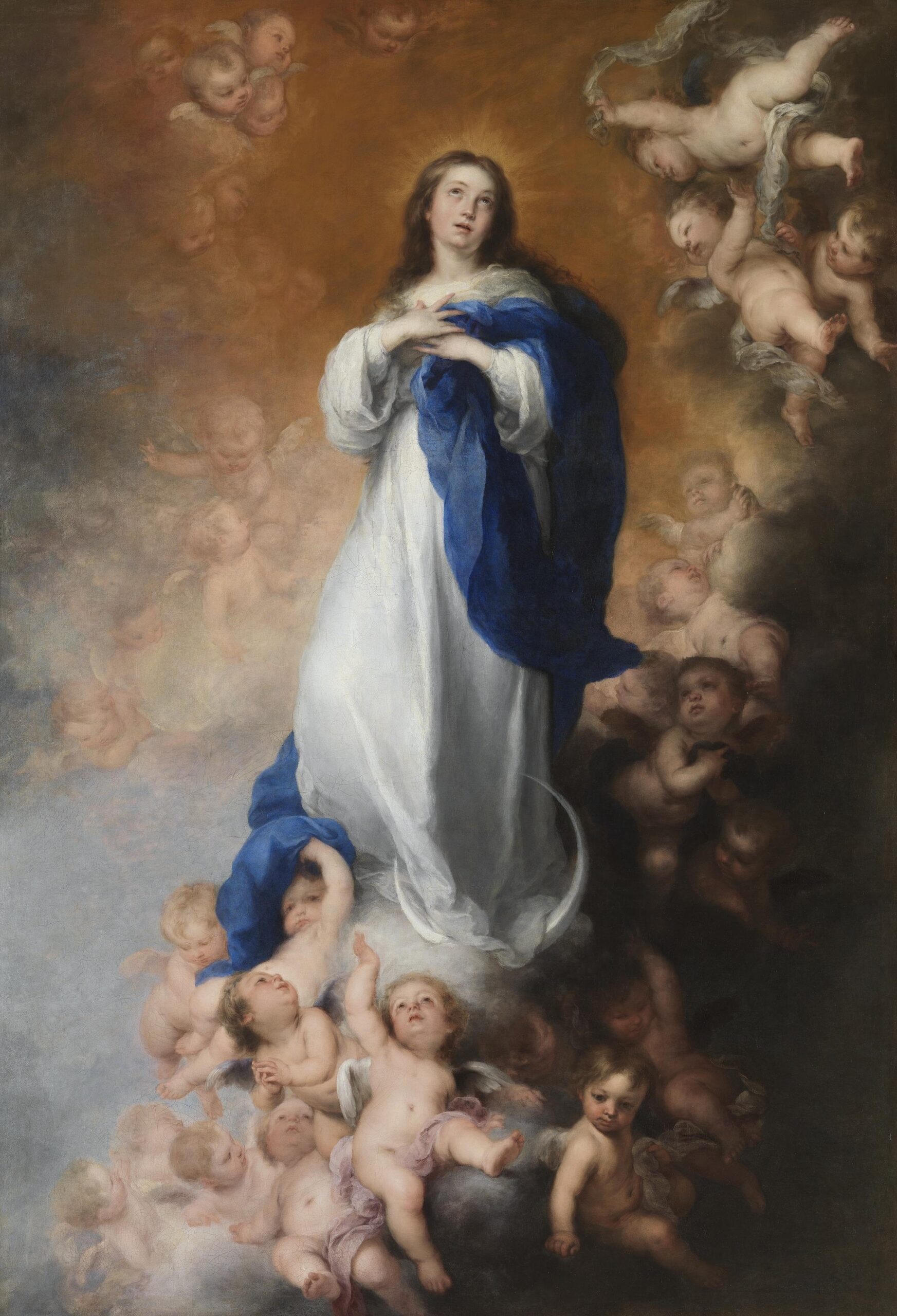
The most famous of these is the Immaculate Conception of the Venerables, known as the Soult Immaculate, by Bartolomé Esteban Murillo. Soult tore it from the Hospital de los Venerables in Seville in 1813 and kept it in his private collection in France until 1852. After his death, King Louis Philippe acquired it for the Louvre. Spain did not recover it until 1940 — after paying a hefty price — and it now hangs in the Prado Museum.
King Joseph’s Baggage
During his flight after the Battle of Vitoria (June 21, 1813), Joseph Bonaparte attempted to take to France an immense artistic booty: more than two hundred carts loaded with works from Madrid, El Escorial and the Royal Palace. Spanish guerrillas and allied troops captured what became known as “King Joseph’s Baggage,” recovering a portion of the treasure. But much had already left Spain during the preceding five years and never returned.
Silver and Sacred Art
Paintings were not the only targets. Silverwork — statues, monstrances, chalices, candelabra — was especially vulnerable because it was easily transportable and meltable. In Zaragoza, the silver statue of Saint Michael the Archangel vanished forever, along with the rich silver bed of the Recumbent Christ. In the church of Vegas de Matute (Segovia), the French carried off more than thirty silver objects from a single church in July 1812.
The Confiscations: Looting by Law
If Napoleonic looting was raw violence, what followed was bureaucratic but equally devastating. The 19th-century confiscations — especially those of Mendizábal (1836–1837) and Madoz (1855) — nationalized and sold the properties of the Church and religious orders.
The stated goal was to finance public debt and modernize the country. The effect on cultural heritage was catastrophic. Thousands of convents and monasteries were closed. Their libraries, altarpieces, sculptures, and paintings were abandoned, looted by private individuals, or sold at bargain prices.
The Plunder of Convent Libraries
The quietest thefts were of books. Spanish convent libraries held manuscripts, incunabula, and first editions of immeasurable value. Many were burned to make space. Others were sold by the kilo to foreign merchants who knew exactly what they were looking for. The National Library of Spain received some 70,000 volumes from Madrid’s convents, but what was lost or sold abroad was far greater.
Capitals, Altarpieces, and Dismembered Works
The creation of provincial Fine Arts museums from 1838 onward attempted to mitigate the disaster, but the damage was already done. Today, Romanesque capitals from the monastery of Santa María la Real (Aguilar de Campoo, Palencia) can be seen in the National Archaeological Museum of Madrid, torn from their original setting. Pedro Berruguete’s altarpieces from the Monastery of Santo Tomás in Ávila were dismembered and are now fragmented across several museums.
The same fate befell the Monastery of Poblet (Tarragona): the mausoleum of the Kings of Aragon was destroyed by local residents during the 1834 revolution, with the progressive authorities looking the other way.
The 20th Century: War, Fires, and Forced Exile
The Civil War and the Protection of Heritage
During the Spanish Civil War (1936–1939), artistic patrimony suffered once more. The burning of convents and churches in the first months of the conflict — more than a hundred buildings set ablaze in Madrid alone — caused irreparable losses.
Yet a remarkable paradox emerged: the Republican government created the Committee for the Seizure and Protection of Artistic Heritage, which managed to save the Prado Museum’s masterpieces by evacuating them first to Valencia, then to Figueres, and finally to Geneva, Switzerland. Picasso’s Guernica, painted for the Spanish Pavilion at the 1937 Paris International Exposition, began its own exile at this time — it would not return to Spain until 1981, now housed in Madrid’s Reina Sofía Museum.
But many other treasures did not share that fate. The burning of the Jesuit Casa Profesa in Madrid — where priceless incunabula by Lope de Vega, Calderón, and Quevedo went up in flames — was a devastating cultural loss.
Michelangelo’s Shattered Sculpture
One of the most tragic episodes was the destruction of the Young Saint John the Baptist of Úbeda, the only sculpture by Michelangelo ever to exist in Spain. During the Civil War, members of the railway workers’ union of the UGT smashed it to fragments. It was only decades later that the Prado Museum managed to restore and re-exhibit it — its scars a permanent reminder of a wound that will never completely heal.
Connection to the Geopolitics of Control Series
The plunder of Spanish art fits perfectly into the central thesis of our research: control is exercised not only through debt, military force, or technology. Cultural control — the appropriation of a country’s artistic heritage — is one of the most subtle and effective levers of domination.
As we explored in Pedro Baños and the 7 Levers of Domination and Soft Power and Cultural Control, stripping a nation of its artistic heritage is not merely stealing valuable objects: it is amputating its collective memory, stripping away the symbols that define it, and transferring that symbolic power to the country that displays them in its museums.
The Louvre, the British Museum, and the Gemäldegalerie in Berlin are not just temples of art: they are showcases of the spoils of war of the powers that built them. Every Murillo in the Louvre, every Zurbarán in a British collection, every Spanish manuscript in a German library is a trophy of a silent war for the control of memory.
As we saw in The Dismantling of the Spanish Empire and Soft Power and Cultural Control, the loss of artistic patrimony is not an isolated event: it is another piece of the puzzle of control through debt, diplomatic pressure, and cultural domination that Spain has suffered for centuries.
FAQ
How many works of art did Spain lose during the Napoleonic invasion?
Estimates indicate over 1,500 paintings left Madrid and its surroundings, and approximately 1,000 from Seville. Marshal Soult alone appropriated more than 180 works. Many never returned and now adorn museums like the Louvre or private collections.
What was the Soult Immaculate Conception?
It is a masterpiece by Bartolomé Esteban Murillo painted for the Hospital de los Venerables in Seville. Marshal Soult stole it during the French occupation and kept it in his private collection until his death. Spain recovered it in 1940 after paying a million-dollar sum to the French state.
Was the Mendizábal confiscation a form of looting?
Yes, even though it was legal. The nationalization and sale of Church property between 1836 and 1837 caused the loss of an immense cultural heritage: thousands of artworks, entire libraries, altarpieces, and liturgical objects were dispersed, sold at bargain prices, or destroyed.
What role did the Prado Museum play in protecting art during the Civil War?
The Republican government created the Committee for the Seizure and Protection of Artistic Heritage, which successfully evacuated the Prado’s masterpieces to Valencia, Figueres, and Geneva. It was one of the most impressive art rescue operations in history, though not all works were so fortunate.
Does Spain still claim looted works today?
Yes, though with limited success. Spain has claimed works in museums worldwide, but international law on looted cultural property is complex and generally favors the possessing countries. The recovery of the Soult Immaculate in 1940 or the Guernica in 1981 are exceptions rather than the rule.
Conclusion
The history of the plunder of Spanish art is not merely a story of cultural losses. It is the story of how power uses every available tool — including art — to weaken the peoples it seeks to dominate. Tearing a Murillo painting from its Seville church is not unlike imposing a foreign debt that mortgages a country: both are forms of control.
Spain’s artistic heritage was looted again and again: by Napoleon’s troops, by French generals, by legal confiscation processes, by the fires of the Civil War. Today, part of that lost heritage can be seen in the great museums of the world — the Louvre, the Gemäldegalerie, British private collections — with few visitors knowing those works were torn from their homeland by force or by law.
Recovering the memory of that plunder is the first step toward understanding that cultural control is one of the deepest forms of domination. Because whoever controls a people’s art, controls their identity.
📚 Related Books
- The Plunder of the Arts in the Napoleonic Wars — VV.AA.
- Church Wealth in Spain: The Mendizábal Confiscations — Germán Rueda
- The Prado Museum: From Napoleonic Looting to Civil War Evacuation — Gabriele Finaldi
- Spain’s Artistic Heritage: A History of Plunder and Recovery — Jonathan Brown
Featured image: The Soult Immaculate Conception by Bartolomé Esteban Murillo (1678). Public domain. The painting was looted by Marshal Soult during the Napoleonic invasion of Spain and is now displayed at the Prado Museum.
