Introduction
Some wars are fought with swords and cannons. Others are fought with words, images, and propaganda. The Spanish Black Legend was the second kind: a propaganda campaign that began in the 16th century and, in many ways, has not ended.
England, the Dutch Republic, and European Protestantism built over centuries an image of Spain as a cruel, fanatical, obscurantist, and tyrannical nation. This was not occasional criticism: it was a systematic propaganda machine designed to delegitimize the Spanish Empire and justify the rise of the powers that challenged it.
As explored in Soft Power and Cultural Control and Media and Propaganda, narrative control is one of the most powerful levers of domination. The Black Legend was the first great example of that lever in action.
What Is the Black Legend?
The term was popularized by Spanish historian and sociologist Julián Juderías in 1914, in his book The Black Legend. Juderías defined it as:
“The atmosphere created by the fantastic tales about our homeland that have seen the light in all countries, the grotesque descriptions of the character of Spaniards as individuals and as a collective, the denial or systematic ignorance of everything favorable in our culture and art.”
American historian Philip Wayne Powell, in Tree of Hate (1971), was more precise:
“The basic premise of the Black Legend is that Spaniards have shown themselves, historically, to be uniquely cruel, bigoted, tyrannical, obscurantist, lazy, fanatical, greedy, and treacherous.”
That is, it was not about criticizing specific Spanish actions (which existed, as in all empires), but about turning the Spaniard into an archetype of evil, a monstrous exception among European nations. Philosopher Julián Marías summarized it: “The Black Legend consists of extending the condemnation and disqualification of an entire country throughout all its history, including its future, starting from a concrete point.”
The Origin: 16th Century Protestant Propaganda
The Black Legend was born in the context of the 16th century wars of religion. The Netherlands (then a Spanish possession) rebelled against Philip II, and the political struggle was waged both on battlefields and in printing presses.
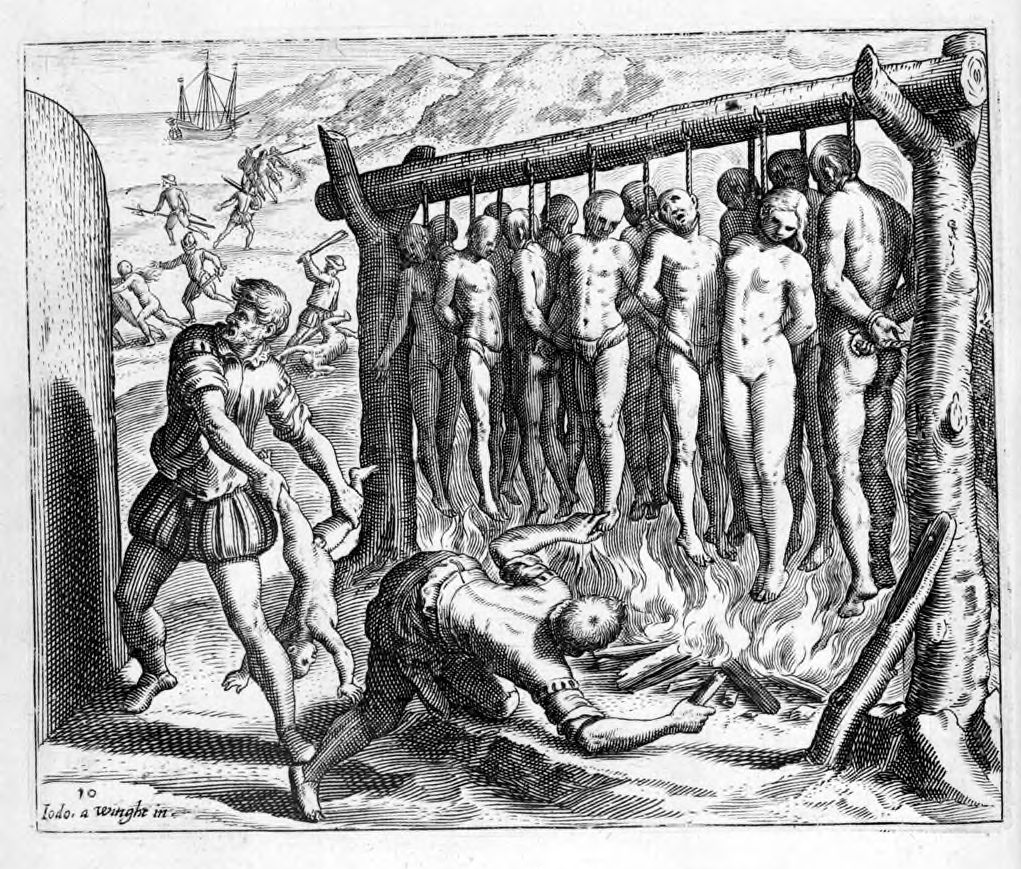
Dutch and English propagandists developed a publishing industry dedicated to demonizing Spain. Flemish engraver Theodor de Bry (1528-1598) published a series of illustrations showing Spaniards torturing and burning Native Americans alive. His engravings, based on the writings of Dominican friar Bartolomé de las Casas, spread throughout Europe with titles like “Horrible atrocities of the Spaniards in Cuba: a true and authentic account of the cruel massacre and murder of 20 million people in the West Indies by the Spaniards.”
De las Casas’ A Short Account of the Destruction of the Indies (1552) — originally written to denounce abuses to the Spanish Crown — was hijacked by Protestant propaganda and republished with de Bry’s illustrations that multiplied and distorted the horrors. Spain had been the first country in the world to denounce abuses against indigenous peoples (with the Laws of Burgos of 1512 and the New Laws of 1542), but that part of history is rarely told.
The “Protestant Inquisition” No One Mentions
While anti-Spanish propaganda focused on the Inquisition as a symbol of Spanish intolerance, Protestant countries burned heretics with equal or greater zeal. The witch hunts in Germany, England, and Scotland caused tens of thousands of executions. Protestant theologian John Calvin ordered the burning of Michael Servetus in Geneva. But those stories were not spread with the same intensity. The difference was in the control of the narrative: Protestants controlled the printing presses of Northern Europe, and Spain had no comparable propaganda machinery.
England and the War Against Spain
The Anglo-Spanish rivalry was the main engine of the Black Legend. England, under Elizabeth I, needed to justify its overseas expansion and its challenge to Spanish power. English privateers — Francis Drake, John Hawkins — were presented as national heroes, while Spaniards were portrayed as cruel tyrants.
The Spanish Armada (1588) was a propaganda milestone. The defeat of the Spanish fleet was exploited throughout Europe as proof that God was on the side of the Protestants. English presses produced hundreds of pamphlets, engravings, and ballads satirizing Spaniards.
The Spanish-American War of 1898 reactivated the Black Legend with renewed intensity. As explored in Soft Power and Cultural Control, the American yellow press (Hearst, Pulitzer) justified intervention in Cuba by portraying Spaniards as inhuman barbarians. The explosion of the Maine was the excuse, but the breeding ground was the Black Legend, which had been three centuries in the making.
The Legacy of the Black Legend in the 20th and 21st Centuries
Cinema and Popular Culture
20th-century Hollywood inherited and amplified the Black Legend. Films like The Mask of Zorro, The Mission, Captain Blood, and Pirates of the Caribbean systematically present Spaniards as cruel villains, religious fanatics, or grotesque characters. Meanwhile, the English and French empires are rarely portrayed with the same harshness. As explored in Soft Power and Cultural Control, the entertainment industry is a tool of narrative control as effective as any propaganda campaign.
The Persistence of Stereotypes
The stereotypes of the Black Legend persist today: the violent, bloodthirsty Spain of bullfighting, the religious fanaticism associated with the Spanish, laziness (the “siesta” as cliché), innate corruption. These stereotypes are not innocent: they are the legacy of four centuries of deliberate propaganda.
The Historiographical Debate
Not all historians agree on the existence of the Black Legend. British Hispanist Henry Kamen argues that the concept has been overcome and that prejudices about Spain are no different from those about other countries. Spanish historian Ricardo García Cárcel considers it “neither a legend, insofar as the criticisms had historical foundation, nor black, given that the tone was never constant or uniform.”
However, for authors like Iván Vélez or José Antonio Vaca de Osma, the Black Legend remains active and conditions the international perception of Spain, even affecting foreign policy and relations with Latin America.
Connection to the Geopolitics of Control Series
The Black Legend is the most perfect example of the media lever and the mental lever of Pedro Baños’ 7 Levers of Domination. It is the manufacturing of consent applied at a global scale over centuries. As seen in Pedro Baños and the 7 Levers of Global Domination, control of the narrative is as important as military or economic control.
The Black Legend also connects to the digital colonialism explored in another article: if in the 16th century de Bry’s engravings demonized Spain, today the algorithms of digital platforms amplify certain stereotypes while silencing others. Technology changes, but the mechanics of narrative control remain the same.
And of course, the Black Legend is another piece in the puzzle of the Spain: Laboratory of Control sub-series, which has already explored how power has controlled Spain through the plunder of artworks, the economic pressure of the Marshall Plan, and external debt.
FAQ
Who coined the term “Black Legend”?
The term was popularized by Julián Juderías in his book The Black Legend (1914), although Emilia Pardo Bazán and Vicente Blasco Ibáñez had used it before. Juderías defined the concept as the systematic propaganda against Spain that distorted its history and national character.
Was the Spanish Empire especially cruel?
No more than other empires. Spain committed abuses, like all colonial empires, but it was also a pioneer in legislating the protection of indigenous peoples (Laws of Burgos, 1512). The difference is that the propaganda of its rivals turned those abuses into the only characteristic of the Spanish Empire, while the crimes of other empires were minimized or forgotten.
Is the Black Legend still active today?
Yes, though in more subtle forms. Hollywood, English-language literature, and the educational systems of many countries perpetuate Black Legend stereotypes. However, in recent decades a historiographical movement has grown that seeks to dismantle these myths.
What is its relationship with the conquest of America?
The Black Legend uses the conquest of America as its main argument, magnifying abuses and hiding the positive aspects of Spanish colonization, such as the creation of universities, racial mixing, or the legal protection of indigenous peoples.
What is the difference between legitimate criticism and the Black Legend?
Legitimate criticism recognizes Spain’s errors while contextualizing them. The Black Legend, on the other hand, uses them to disqualify an entire country, its history, and its culture, applying a different standard than that used to judge other nations.
Conclusion
The Spanish Black Legend is the longest-running propaganda campaign in history. It has been operating for more than four centuries, shaping the international perception of Spain and Spaniards. It was born as a weapon of war in the conflict between Catholic Spain and the Protestant powers, and has evolved to the present day in the form of cultural clichés, academic prejudices, and cinematic narratives.
Understanding the Black Legend is not about denying Spain’s errors. It is about understanding that power is not only exercised through armies and money: it is also exercised through storytelling. And for four centuries, Spain’s enemies told a very convincing story. The question is: when will we start telling ours?
📚 Related Books
- La leyenda negra (The Black Legend) — Julián Juderías (1914)
- Tree of Hate: Propaganda and Prejudices Affecting Relations with the Hispanic World — Philip Wayne Powell (1971)
- The Black Legend: History and Opinion — Ricardo García Cárcel & Lourdes Mateo Bretos (1991)
- Spain Against Its Ghosts — Iván Vélez
Featured image: engraving by Theodor de Bry (ca. 1590). Public domain. De Bry’s engravings were instrumental in spreading the anti-Spanish Black Legend in 16th-century Protestant Europe.