Introduction
If there is one place on Earth where territorial control has been elevated to an applied science, that place is Palestine. Since 1967, when Israel occupied the West Bank, Gaza, East Jerusalem and the Golan Heights during the Six-Day War, the Palestinian territories have been subjected to a systematic process of fragmentation, colonization and control — one that international bodies, including the International Court of Justice (ICJ) and Amnesty International, have declared illegal under international law, and which Amnesty, Human Rights Watch and the ICJ itself have described as apartheid.
This is not a «conflict» between two equal parties, as the media often frames it. It is a unilateral military occupation that has lasted for more than half a century, backed by the military, economic and diplomatic power of the world’s leading superpower. It is, in essence, a laboratory of territorial control where all seven levers of domination identified by Pedro Baños are deployed simultaneously.
The legal framework: occupation or annexation?
Israel’s occupation of the Palestinian territories began in June 1967. Since then, international law has been unequivocal: Article 49 of the Fourth Geneva Convention explicitly prohibits an occupying power from transferring its civilian population into the territories it occupies. This is not a recommendation — it is a rule of international humanitarian law, and its violation constitutes a war crime.
In 2004, the International Court of Justice issued an advisory opinion declaring the separation wall built by Israel inside the West Bank illegal, along with the settlements. In February 2024, the ICJ went further: in a landmark opinion, it ruled that Israel’s occupation as a whole was illegal and that Israel had «an obligation to cease immediately all new settlement activities and to evacuate all settlers» from the occupied territories.
Yet despite UN resolutions, reports from Amnesty International and ICJ rulings, the settlements have not only continued but accelerated. In 2024, according to an EU report, the Israeli government «continued to deepen the settlement project in the occupied Palestinian territory, advancing plans that further endanger Palestinian development and territorial contiguity».
The reason is simple: international law only works when there is political will to enforce it. That will has been conspicuously absent, largely due to the systematic use of the US veto in the UN Security Council against any resolution that would impose sanctions on Israel.
The settlement system: colonization in real time
Israeli settlements are the central mechanism of territorial control in the West Bank. They are not innocent residential neighborhoods: they are outposts of an occupying power built on land confiscated from Palestinians, connected by a network of settlers-only bypass roads, and protected by the Israeli military.
As of 2023, there are 144 official settlements in the West Bank (12 of them in East Jerusalem) and at least 196 unauthorized outposts tolerated by the Israeli government. In total, over 450,000 Israeli settlers live in the West Bank (excluding East Jerusalem), where another 220,000 settlers reside. An additional 25,000 settlers live in the occupied Syrian Golan Heights.
The settler population has grown relentlessly. Over the past three decades, it has roughly doubled every fifteen years. This growth is not spontaneous: it responds to deliberate government policies that offer tax breaks, housing subsidies and other incentives to those who move to the occupied territories.
The map of control: Areas A, B and C
One of the most sophisticated control mechanisms is the division of the West Bank into three areas under the Oslo Accords (1993):
- Area A (18% of the territory): Palestinian administrative and security control. In practice, these are fragmented islands disconnected from each other.
- Area B (22% of the territory): Palestinian administrative control, Israeli security control.
- Area C (60% of the territory): Full Israeli control. This is where all settlements, bypass roads, nature reserves and strategic resources such as water are concentrated.
This division is not neutral. Area C contains most of the fertile land, the aquifers and the connections between Palestinian cities. By maintaining total control over 60% of the territory, Israel decides where Palestinian cities can expand, where land can be cultivated and where Palestinians can travel.
The result is deliberate fragmentation: Palestinian cities are like archipelagos separated by a sea of Israeli-controlled territory. To travel from Ramallah to Hebron, a Palestinian must cross multiple checkpoints, take secondary roads (the main ones are reserved for settlers), and navigate a permit system that can be denied without explanation.
The separation wall: physical and symbolic control
In 2002, during the Second Intifada, Israel began building the so-called «security fence» or «separation barrier.» In reality, it is a system of barriers stretching 759 kilometers, consisting of 90% electrified fences with sensors and 10% concrete walls up to 8 meters high.
The wall’s route is revealing: it does not follow the Green Line (the pre-1967 border) but cuts deep into Palestinian territory, encircling settlements and effectively annexing large swaths of land. The ICJ ruled in 2004 that 85% of its route runs inside the West Bank, not on the border. Rather than separating Israel from Palestine, the wall separates Palestinians from their land.
The humanitarian impact is devastating: the wall isolates entire communities, severs farmers from their fields, blocks access to hospitals and schools, and has destroyed the local economy. According to the UN, the wall has confiscated or isolated more than 10% of the West Bank’s territory.
Checkpoints and movement control
The system of population control goes far beyond the wall. In the West Bank, the Israeli military maintains a network of over 600 movement obstacles: permanent and temporary checkpoints, road barriers, earth mounds, iron gates and tunnels.
According to OCHA (the UN Office for the Coordination of Humanitarian Affairs), in 2023 there were 49 permanently manned checkpoints, 139 occasionally manned checkpoints, and 304 additional physical barriers. Added to this are access restrictions to the so-called «Gaza Strip Buffer Zone» (agricultural land near the Gaza border within the West Bank), closed military zones and unilaterally declared nature reserves.
The permit system adds another layer of control: Palestinians need military authorization for almost everything — leaving the country, traveling between the West Bank and Gaza, accessing East Jerusalem, working in Israel, or even moving between Palestinian cities. These permits can be denied or revoked arbitrarily, with no explanation required.
This is not a conventional security system. It is, as human rights organizations have documented, a bureaucratic control apparatus that keeps the Palestinian population in a permanent state of uncertainty and dependency.
Water control: thirst as a strategy
One of the least visible but most effective tools of territorial control is water management. The West Bank aquifers provide roughly a third of Israel’s fresh water. Yet water consumption is radically unequal.
According to UN data, an Israeli settler consumes four to five times more water than a Palestinian in the West Bank. Settlement swimming pools, golf courses and lush gardens contrast with the water shortages in Palestinian cities, where running water may arrive only a few hours a day.
Israeli control over Area C means that any Palestinian well, pipe or water infrastructure requires a military permit — permits that are systematically denied. Meanwhile, settlements have unlimited access to water from the same shared aquifer, extracted through Mekorot, the Israeli national water company.
Territorial fragmentation worsens the problem: Palestinian villages isolated by the wall, checkpoints or settler roads typically have far worse water access. This is not an accidental consequence of geography, but a direct result of territorial control policies.
The Palestinian Authority: administration or collaboration?
A key element of the control system is the Palestinian Authority (PA) itself, created by the Oslo Accords. In theory, the PA is the Palestinian self-government. In practice, it functions as a subordinate administration that manages civil affairs in the Palestinian islands (Areas A and B) while Israel retains ultimate control over the entire territory.
The PA has no real sovereignty: it does not control its borders, its airspace, its water resources, its population registry or its land cadastre. It depends on customs revenue that Israel collects on its behalf and can arbitrarily withhold as leverage (and has done so repeatedly). Its security forces coordinate with the Israeli military. Its political capacity is constrained by the occupation.
Some analysts describe the PA as an «outsourcing of control» mechanism: Israel externalizes the management of the Palestinian population to a powerlessness administration that absorbs discontent and maintains order, while Israel retains strategic control over territory, resources and security.
Gaza: the laboratory of total control
If the West Bank is an example of territorial micro-management, Gaza is the extreme case of control through isolation. Since Hamas took control in 2007, Israel has imposed a land, sea and air blockade that the UN has called collective punishment — a violation of international humanitarian law.
The blockade controls everything entering and leaving Gaza: food, medicine, construction materials, fuel, people. The population of 2.3 million people is trapped in what has been called «the world’s largest open-air prison.»
The military disproportionality turns any escalation into a massacre. Israeli bombardments on Gaza have destroyed entire neighborhoods, hospitals, schools and universities, in operations that organizations like Amnesty International have documented as possible war crimes.
Control in Gaza is total in every sense: physical (the siege), military (the bombings), economic (the blockade prevents recovery), demographic (movement is restricted) and media (access for international journalists is heavily restricted).
Connection with the Geopolitics of Control series
The Palestinian case perfectly illustrates the central thesis of our series: power expands by nature, as Bertrand de Jouvenel already noted, and when it meets resistance, it deploys every available lever to impose itself.
In Palestine we see virtually all of Pedro Baños’ 7 levers of domination in action:
- Military: Direct occupation, permanent army in occupied territory, bombings, checkpoints.
- Economic: Customs control, water, resources, work permits, Gaza blockade.
- Technological: Digital surveillance system, cameras, drones, facial recognition at checkpoints, the «Blue Wolf» population control system.
- Diplomatic: US veto at the UN, normalization agreements (Abraham Accords), international legitimization.
- Media: Narrative of a symmetric «conflict», accusations of anti-Semitism against critics, AIPAC lobbying.
- Cultural: Normalization of the occupation in Israeli and Western public discourse.
- Mental: The construction of the Palestinian as an existential threat, systematic dehumanization.
Aníbal Quijano’s coloniality of power manifests here in its purest form: the military occupation did not end when the Oslo Accords were signed — it adapted, transforming into a more sophisticated control system that combines direct colonization, bureaucracy, technology and economic dependency.
And as David Graeber taught us, state violence is the foundation of this entire system: the markets, the economy and the «order» in the occupied territories do not exist despite the occupation — they exist because of the violence that sustains it.
This article continues the thread from our introductory article and the previous piece on the creation of Israel as a geopolitical tool. If that article analyzed how the state was created, this one shows how it has been used for over half a century as an instrument of regional control. Both draw on the theoretical framework of the thinker tree of control we have developed in this series, from Jouvenel and Graeber to Baños.
FAQ
Are Israeli settlements legal under international law?
No. Article 49 of the Fourth Geneva Convention prohibits an occupying power from transferring its civilian population to occupied territory. The ICJ, the UN and the international community consider the settlements illegal. In 2024, the ICJ ruled that the Israeli occupation as a whole is illegal.
How many Israeli settlers live in occupied territories?
Over 670,000 settlers in the West Bank and East Jerusalem (450,000 in the West Bank excluding East Jerusalem, plus 220,000 in East Jerusalem), as well as 25,000 in the occupied Syrian Golan Heights.
What is the difference between Areas A, B and C in the West Bank?
Area A (18%) is under Palestinian control, Area B (22%) has Palestinian administration but Israeli security, and Area C (60%) is under full Israeli control. Area C contains all settlements, water resources and the connections between Palestinian cities.
What does the international community say about the separation wall?
The ICJ ruled in 2004 that the wall is illegal because 85% of its route runs inside the West Bank, not on the border. The UN General Assembly has passed resolutions demanding its removal.
Is the Israeli system apartheid?
Yes, according to Amnesty International (2022), Human Rights Watch (2021) and the ICJ itself (2024), which have documented that Israel’s control system over the Palestinian territories constitutes apartheid under international law, including persecution based on nationality and ethnicity.
Conclusion
The Palestinian occupation is not just another conflict on the global chessboard. It is the perfect case study for understanding how territorial control operates in the 21st century: through direct colonization, geographic fragmentation, bureaucratic control, surveillance technology and a carefully constructed media narrative.
What makes the Palestinian case unique is that all these techniques are deployed in a very small territory, under the world’s watch, and yet they continue with impunity for over five decades. The occupation of Palestine is not an anomaly: it is a mirror reflecting the mechanisms of control that operate, in subtler forms, across the entire planet.
For the global justice movement, Palestine has become the defining cause of a generation. For us at Geopolitics of Control, it is the confirmation that the seven levers of domination are not an abstract theory: they are applied every day, to millions of people, while the world watches.
In the next article of this series we will explore the petrodollar: how the control of oil and the global currency became the financial weapon that has shaped the Middle East over the last five decades.
📚 Related Books
- Palestine: A History of Occupation — Noam Chomsky and Ilan Pappé
- The Question of Palestine — Edward Said
- The Biggest Prison on Earth: A History of the Occupied Territories — Ilan Pappé
- Israel’s Apartheid: A Beginner’s Guide — Ben White
- The Ethnic Cleansing of Palestine — Ilan Pappé
- The One-State Condition: Occupation and Democracy in Israel/Palestine — Ariella Azoulay and Adi Ophir
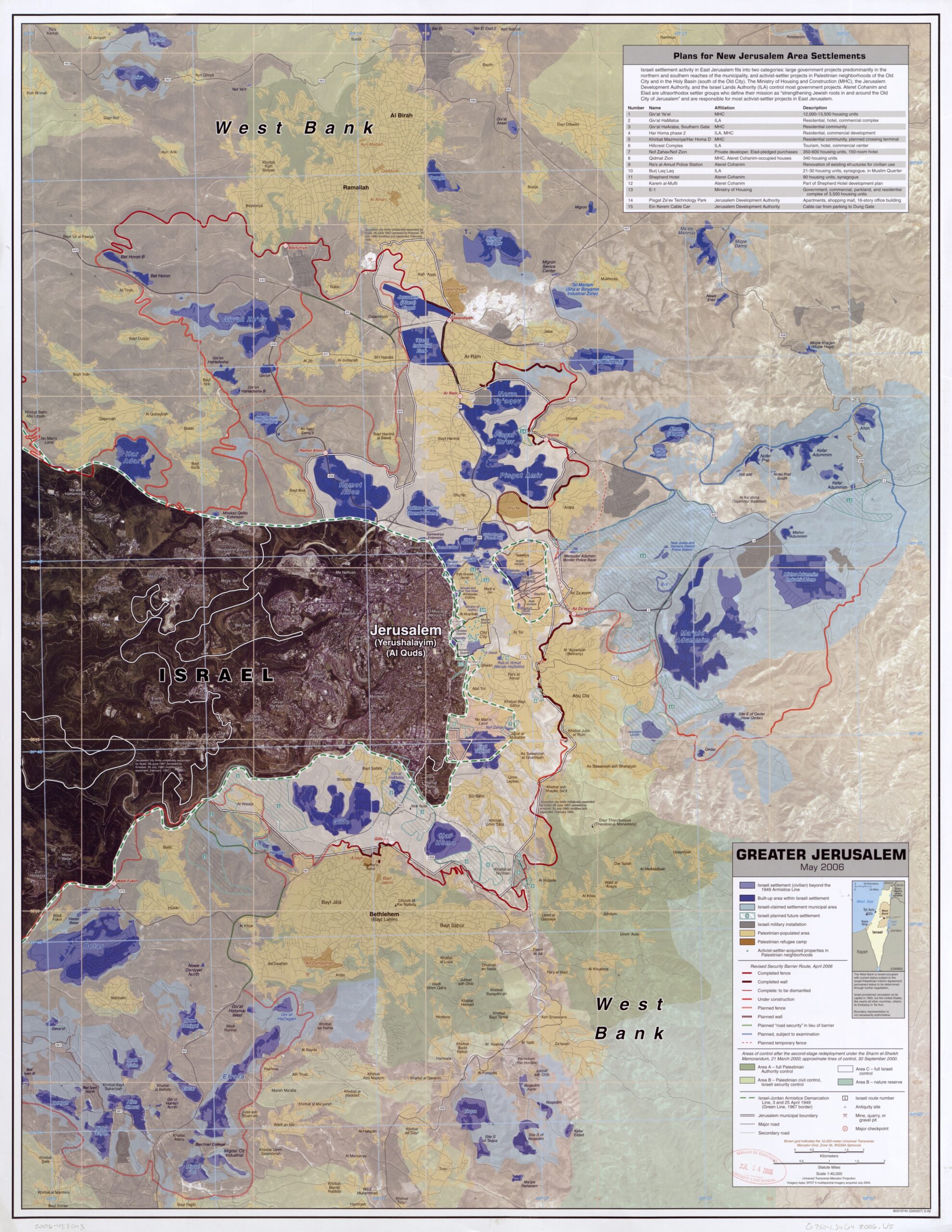
Featured image: Greater Jerusalem satellite map (2006) by CIA, public domain, via Wikimedia Commons.