Introduction
Between the mid-1980s and early 2000s, Spain carried out one of the most intense privatization processes in Europe. Over 120 state-owned companies were sold, generating approximately 45 billion euros in revenue. What was presented at the time as economic modernization and integration into globalization was, in retrospect, an auction of Spain’s industrial sovereignty.
Spain’s privatizations were not an isolated phenomenon but part of a global wave driven by the Washington Consensus, the IMF, and the European Union. However, the Spanish case has a particularity: the country had just emerged from a dictatorship and was building its democracy precisely when it decided to dismantle the policy instruments that any sovereign state needs. The consequences of that decision are still being paid today.
Context: The INI and the State as Entrepreneur
To understand what was lost, one must understand what existed. The Instituto Nacional de Industria (INI), created in 1941, was the state holding company that grouped Spain’s strategic industries. Inspired by Italy’s IRI, the INI had built over decades an industrial fabric spanning energy (Endesa, Repsol, Gas Natural), telecommunications (Telefonica), banking (Argentaria), tobacco (Tabacalera), aerospace (CASA), steel (Ensidesa), automotive (SEAT, ENASA), shipbuilding (Astander, Astano), air transport (Iberia), shipping (Trasatlántica), and many others.
By the 1980s, the INI employed over 250,000 workers and generated a significant share of Spain’s industrial GDP. Companies like Telefonica were considered strategic not only for their size but because they controlled critical infrastructure for the country’s development.
First Wave: Felipe González (1982-1996)
The first Socialist government of Felipe González came to power in 1982 with a Keynesian program and a promise to create 800,000 jobs. However, Spain’s entry into the European Economic Community in 1986, pressure from the IMF, and the growing influence of neoliberal ideas within European social democracy changed the course.
González privatized nearly 80 companies, though many were small or struggling. The strategy was to sell unviable firms first (SEAT to Volkswagen in 1986, ENASA to Iveco) while keeping the crown jewels under partial state control.
But that changed from 1988 onward, when partial privatizations of the most profitable companies began:
- 1988: 18% of Endesa (IPO) — first major partial privatization
- 1989: 26% of Repsol (IPO)
- 1995: 12% of Telefonica
- 1996: 25% of Argentaria
The pattern was identical in every case: the state sold minority stakes, gradually losing effective control of the companies. The revenue was used to reduce the public deficit and meet the Maastricht criteria for joining the euro.
Second Wave: José María Aznar (1996-2004)
If González opened the door, Aznar kicked it down. In just seven years, his government privatized about 50 companies, completing the sales that the Socialists had left half-finished.
1997 was the pivotal year. In just twelve months:
- Telefonica: sale of the remaining 20.9% — 3.7 billion euros
- Endesa (first phase): 25.44% — over 4 billion euros
- Repsol: full privatization
- Iberia: privatization
- Tabacalera (Altadis): continuing from earlier IPOs
1998 was the final blow:
- Endesa (second phase): final 30% — over 6 billion euros in a single IPO
- Argentaria: 29.2% — 2.2 billion euros
- Tabacalera: 54.43% — 1.7 billion euros
In total, the 29 state IPOs carried out between 1986 and today generated about 32 billion euros, most of them concentrated in 1997-1998.
The Problem: Selling the Jewels, Keeping the Debts
The Spanish state followed a pattern that has repeated worldwide: privatize profits, socialize losses. The companies that were sold were profitable and strategic. Those that remained in public hands were mostly loss-making: shipyards, mines, railway companies with historic debts.
The SEPI (successor to INI) was left holding the crisis-ridden companies, while the profitable ones passed into private hands — in many cases, foreign hands.
Who Bought Spain?
The privatized Spanish companies did not end up in the hands of small domestic investors, as promised in the IPO campaigns. Effective control passed to large foreign corporations:
- Endesa: acquired by Italian Enel in 2007 (after a bidding war with German E.ON)
- Telefonica: maintained diversified Spanish capital but lost state protection
- Repsol: privatized, with a hard core of Spanish shareholders (La Caixa) and later Mexican Pemex as a significant stakeholder
- Argentaria: merged with BBV to form BBVA, a private bank
- Tabacalera (Altadis): bought by British Imperial Tobacco in 2008
- Iberia: merged with British Airways (IAG)
- CASA: integrated into EADS (Airbus), a Franco-German-led consortium
- Aceralia: integrated into Arcelor, then ArcelorMittal (Indian capital)
- Enagás: partially privatized, controlled by private investors
- Abertis (Acesa): privatized, later bought by Italian Atlantia
The result: strategic sectors such as energy, telecommunications, banking, aerospace, and steel came to be controlled from abroad.
Deindustrialization and Dependency
The privatizations did not happen in a vacuum. They coincided with a deindustrialization process that affected all of Western Europe, but was especially severe in Spain:
- Industry’s share of Spanish GDP fell from 28% in the 1970s to 14% today.
- The trade balance became structurally negative: Spain imports far more than it exports.
- The economy became dependent on tourism, construction, and services — sectors with low added value.
Energy decisions, R&D investments, industrial policy, and internationalization strategies are no longer made in Madrid. They are decided in boardrooms in Rome, London, Frankfurt, Mumbai, or Beijing.
Connection with the Geopolitics of Control Series
The sale of Spain’s state-owned enterprises fits into several of the levers of domination:
- Economic lever: public debt and deficit as an excuse for privatization. The Maastricht criteria forced the state to sell profitable assets to balance the books.
- Diplomatic lever: pressure from the EU, the IMF, and the Washington Consensus pushed Spain to follow the neoliberal model.
- Cultural lever: the narrative of “modernization” and “private efficiency” versus the supposed inefficiency of the public sector.
As David Graeber wrote in Debt: The First 5,000 Years, debt has been humanity’s oldest tool of control. The Spanish privatizations were a textbook case: an indebted country selling its patrimony to pay down debt, losing sovereignty in the process.
The case of Telefonica is paradigmatic. Created as a state monopoly in 1924, it was the state’s tool for developing the country’s communications infrastructure for decades. When privatized, its logic shifted from strategic to financial: maximize shareholder value, even if that meant relocating decision-making centers and investments abroad. Today, Telefonica is no longer “the company of all Spaniards” — it is a multinational corporation with no patriotic ties.
Related articles:
– Spain’s Foreign Debt in the 80s — how Spain became financially trapped
– The IMF and the World Bank — the guardians of debt
– The Marshall Plan in Spain — the conditions that mortgaged the country
FAQ
How many state-owned companies were privatized in Spain?
Over 120 companies with state participation, according to SEPI. The most important were Endesa, Telefonica, Repsol, Argentaria, Tabacalera (Altadis), Iberia, Gas Natural, Enagás, CASA, and Aceralia.
How much money did the state receive from privatizations?
Approximately 45 billion euros in total, of which about 32 billion came from public stock offerings (IPOs).
Which government privatized more?
Felipe González’s government (Socialist, 1982-1996) privatized nearly 80 companies. José María Aznar’s government (Popular Party, 1996-2004) completed the process with about 50 companies, including the full sales of Endesa, Telefonica, and Argentaria. Both parties applied the same neoliberal model.
Who bought Spain’s privatized companies?
Many ended up in foreign hands: Endesa (Enel, Italian), Tabacalera (Imperial Tobacco, British), Iberia (IAG, British-Spanish), CASA (EADS/Airbus, Franco-German), Aceralia (ArcelorMittal, Indian). Others like Telefonica, Repsol, and Argentaria (BBVA) maintained majority Spanish capital but lost state control.
What were the consequences of privatization for Spain?
Loss of industrial sovereignty, deindustrialization (industry fell from 28% to 14% of GDP), dependence on tourism and construction, and strategic decision-making centers moved abroad.
Conclusion
The sale of Spain’s state-owned enterprises was one of the largest transfers of collective wealth to private hands in European history. It was neither a mistake nor a conspiracy: it was a conscious political decision, driven by debt pressure, EU conditions, and the neoliberal creed that dominated economic thinking at the time.
Three decades later, the balance is clear: Spain lost the instruments to steer its own economy. Decisions about energy, telecommunications, banking, and transportation are made in boardrooms that answer to no one in Spain. Economic sovereignty was auctioned to the highest bidder.
📚 Related Books
- Debt: The First 5,000 Years — David Graeber
- Neo-Colonialism: The Last Stage of Imperialism — Kwame Nkrumah
- Confessions of an Economic Hit Man — John Perkins
- Open Veins of Latin America — Eduardo Galeano
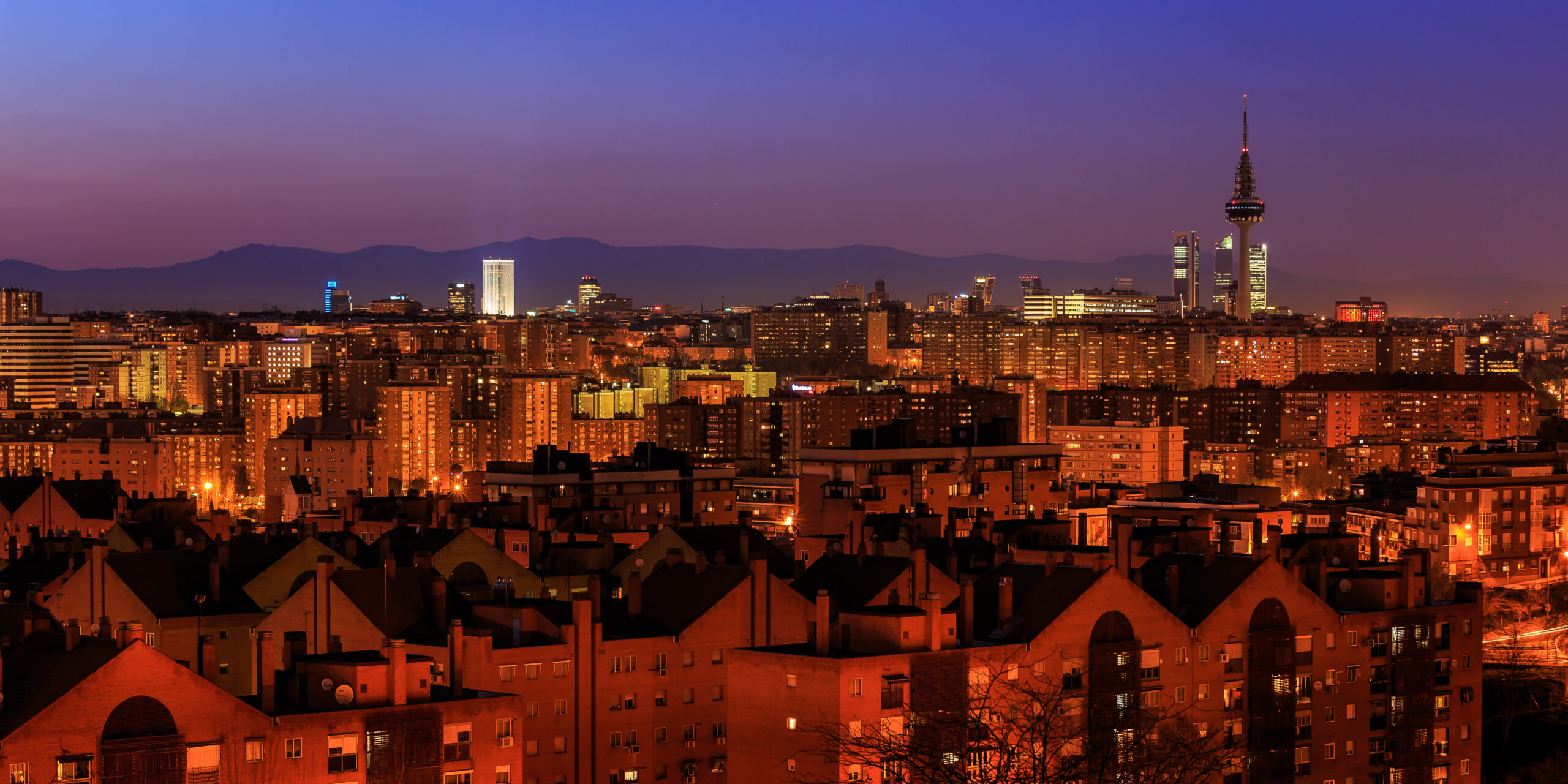
Featured image: Madrid skyline by Barcex, CC BY-SA 4.0, via Wikimedia Commons.